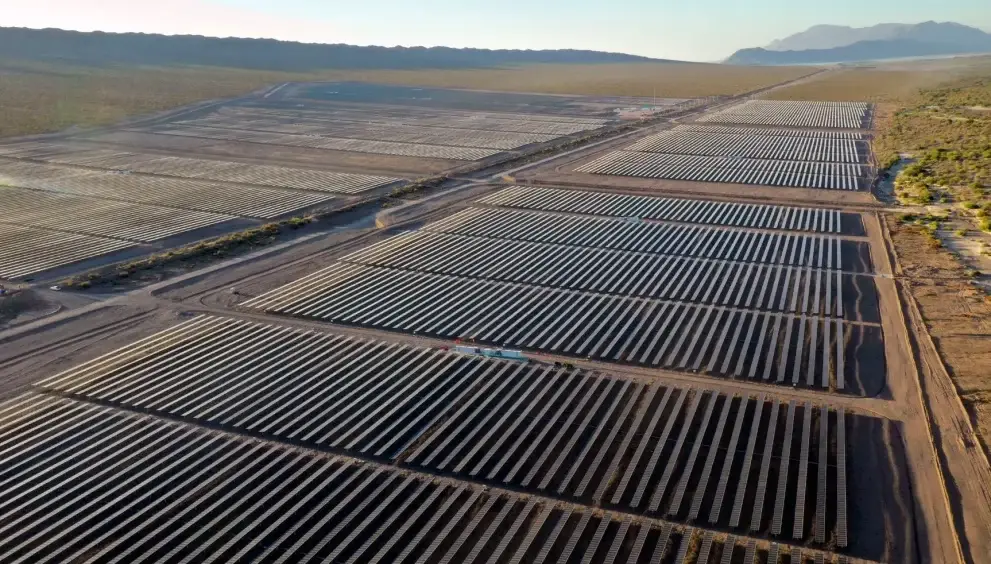
In the country where cheap Vaca Muerta gas is abundant, there is another source of energy that is also competitive. It is the generation of electricity from renewable sources, which currently represents 16.1% of the country’s total matrix, thanks to the construction of wind and solar parks in the last decade. In fact, it is the third source of generation, behind thermal (53%), hydraulic (23.5%) and above nuclear (7.4%).
In the case of hydraulic generation, although it is renewable and clean energy, power plants with an installed capacity greater than 50 megawatts (MW) – such as Yacyretá and the Comahue dams – are not part of Law 27,191, which sanctioned the national promotion regime for the use of renewable sources in 2015. This is because high-power hydroelectric projects, greater than 50 MW, are considered to have a considerable environmental impact. The law in question expires on December 31 and there are already formal requests to the Government in the sector to extend it.
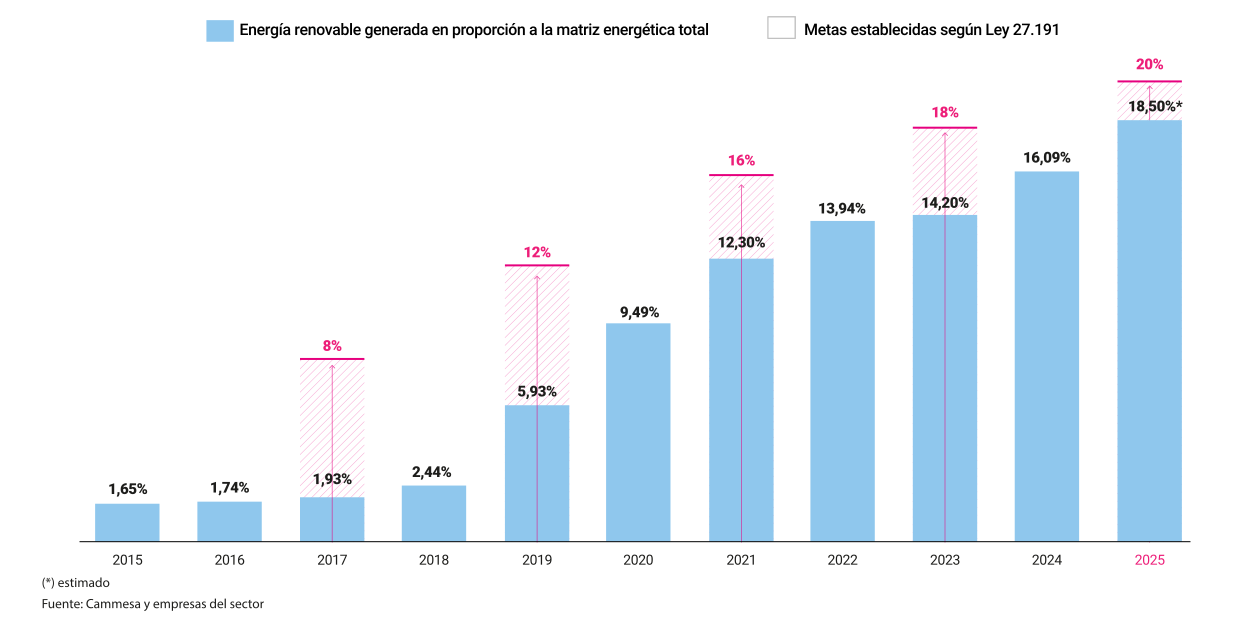
Since it was passed 10 years ago, renewable generation has gone from representing 1.65% of the total matrix to more than 16% in 2024. A target of 20% had been set for this year, but it will end 2025 at around 18.5%, according to the projection of the wind and solar parks that will come into operation in the coming months. In the private sector, however, they point out that despite the adverse context in the last decade of economic crises and political uncertainty (with three presidents from different political parties), the renewable energy market managed to grow quickly. It did so, in addition, even though some of the tax incentives offered by the law were not 100% fulfilled, such as the early return of VAT and the accelerated amortization of assets for the purposes of income tax. “All the incentives that were promised to us were worthless, because the VAT refunds were not made, or they were made late and in pesos despite the inflation that existed,” the companies say.
The law, however, did create a favorable framework that partially insulated the sector from financial turbulence. The signed contracts were respected and the value of the rates was never modified in any of the three governments, as happened with other sources of generation, where the contracts were converted into pesos and updated below inflation. In addition, by adhering to the national law, all provinces allowed for a “fiscal umbrella” by which no governor or mayor could apply a new municipal tax or fee (the town of Puerto Madryn tried to charge a “tax on wind,” but it was unsuccessful). “The law was needed because we are Argentina. If in 20 years we build a reputation, we do not default on more debt and the country risk continues to decrease, no additional protection is needed. But without the law, renewables would not have existed. Today, the sector does not need incentives of any kind, but it needs the law to maintain this fiscal umbrella and to prevent new taxes from being created once the capital is sunk,” says Javier Constanzó, a lawyer specializing in the energy sector and partner at the Tavarone Rovelli Salim & Miani law firm.
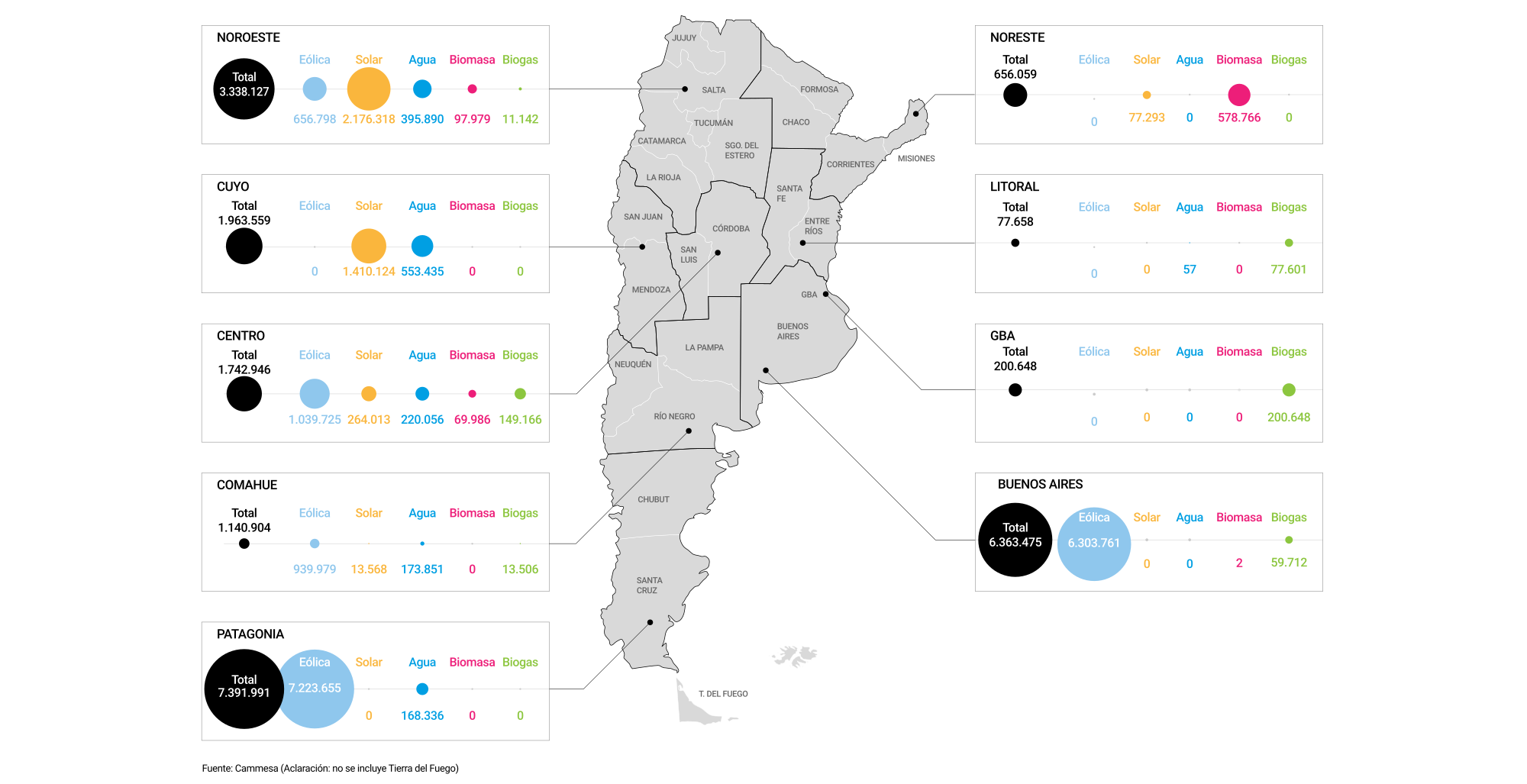
The legal framework also allowed companies to go abroad to seek financing to invest in the construction of the parks, despite the rise in country risk that made interest rates more expensive. From 2018 to 2024, for example, Argentina added new installed capacity to the system for 7,200 MW, of which 5,900 MW were renewable. The average price paid for renewables is increasingly more competitive, as wind turbine and solar panel technology advances. However, due to the freezes in rates for other forms of generation, renewables are now on average the most expensive, with a rate of US$58 per MWh, only below nuclear (US$73). Thermal generation, on average, charges US$39 and hydraulic generation, US$15, according to data from the consulting firm Economía y Energía (EyE), based on information from Cammesa, the state-controlled company in charge of electricity dispatch. These remunerations, likewise, do not include the rate for available power in the case of thermal plants, nor the cost of capital, which is included in renewables. Regarding the future of the sector, the Energy Secretariat told LA NACION: “From the Government we are in favor of the development of renewable energy sources as a private initiative. Companies are free to do so. What this Government is not going to do is restrict the development of conventional energy to promote the development of renewables. We need to exploit our conventional energy sources to ensure energy independence.” Regarding whether they are analyzing extending the renewable energy law, Energy said that “it is being evaluated, although in reality it is the power of the Legislative Branch.” But they added: “We want to continue providing fiscal stability to investors.”
The electric power sector faces several bottlenecks, which limit the growth not only of renewable projects, but of all forms of electricity generation. This is due to the lack of planning by the State and the tariff freeze that prevailed in recent years and discouraged private investment. The main factor is centered on the transmission lines, which determine the size and location where wind and solar parks can be built. “The lack of transmission lines is a restriction for any type of technology, but it affects renewables because investments are made in places that may not be the most optimal, depending on wind and sun conditions, but where there is room to dispatch the energy. In addition, smaller and smaller projects are being built, of no more than 100 MW, which may not be the most ideal in terms of efficiency. There is a lack of infrastructure in general,” says Martín Brandi, CEO of PCR, the company that has 530 MW of renewable energy in operation and is building another solar park in San Luis. The other factor limiting the growth of the electricity sector is demand. When the renewable energy law was passed, the first stage of development took place thanks to the Renovar tenders, in which Cammesa made the awards and gave these projects priority for dispatch. The second stage took place in 2017, with resolution 281 of the Ministry of Energy that created the futures market (Mater), which allowed large users (large companies) to buy electricity directly from renewable energy generators, instead of having to buy from Cammesa, which until then had a monopoly on sales. In this way, the State was removed from the middle and the free negotiation of contracts between private parties was allowed.
This resolution was a complement to the renewable energy law, since large users are also obliged to gradually ensure that part of their electricity consumption comes from renewable sources. Today there are companies that practically supply most of their demand from renewable generation, such as Toyota, Quilmes, Dow, Unilever and Volkswagen. “The problem with Mater is that it is running out, there are fewer and fewer companies to which renewable energy can be sold. Now we have to go looking for consumption from distribution companies, which supply residential demand. Therefore, now there is no problem with the supply of renewables, but the focus is on how demand is ordered. The supply cannot develop if it does not know who the energy is sold to. This is key to then go out and look for financing,” says Bernardo Andrews, general manager of Genneia, the company that leads the renewable energy market with a 19.5% share. In recent weeks, Javier Milei’s government has opened up the Mater even further to allow not only renewables, but other sources of generation to also sell electricity to large companies, in order to advance the decentralisation of the State. The problem is that more than 60% of the demand is bought by electricity distributors, including Edenor and Edesur, which in the last two decades had their rates frozen and did not cover the cost of electricity. “For the market to normalize, distributors also need to be able and willing to buy electricity directly. At first it may be necessary for Cammesa to step in as guarantor because the credit history of the distributors over the last 20 years is bad due to the rate freeze. In the meantime, we continue trying to sell generation to companies, but that market is limited going forward,” said Brandi. Wind and photovoltaic energy in Argentina stand out for their capacity factors, which measure how much time of the day they are generating electricity. In wind power, the capacity factor reaches 50%, while in Europe, the most productive parks do not reach 40%. Solar parks, meanwhile, have a capacity factor of 30%, while in Spain and Italy, which have good resources, they do not reach that percentage.
The construction of a wind farm costs approximately US$150 million for every 100 MW. Although it is more expensive than the US$90 million that it costs to build 100 MW of a solar park, the capacity factor is higher (50% vs 30%). Construction costs, however, the sector warns, are around 15% more expensive than other similar projects in the region because in Argentina there are higher financing costs and because there is a lack of infrastructure to transport wind turbines and solar panels. On the other hand, they point out that a general virtue of renewable projects is that they can be operational in approximately one year, unlike other forms of generation that take longer. “Between 2015 and 2025 there was a period with a lot of macroeconomic instability, with different political party governments and, nevertheless, we are close to meeting the goal of the proportion that renewables represent within the energy matrix. It is an example that we have to take and replicate in other sectors. “It was very successful as it happened, with a first stage where the State intervened a little more with the Renovar contracts, and then came the Mater part, with contracts between private parties, without government interference. Today there is no subsidy to the sector and there is a genuine demand from large users because there is a competitive cost,” summarizes Manuel Santos Uribelarrea (h), founder and president of MSU, the company that was born focused on agricultural business and that in recent years entered the energy sector. They currently have 380 MW of installed capacity operating in photovoltaic energy.
Source: See full article ( Spanish ) La Nacion

Founded in 2004, GTSA began as a single office in Buenos Aires. Since then, it has grown into a vibrant regional network, providing professional real estate marketing services to clients in AR, BR, CL, PY, PE, and UY.