This post is also available in:  Español
Last updated: 27 October 2026 | GTSA editorial team
The 2026–27 El Niño is on track to be one of the strongest on record. Its economic effects will split the Southern Cone in two. Peru, Chile and Uruguay face clear losses to growth. Argentina and Paraguay could earn more from bigger grain harvests. Brazil’s result depends on whether gains in the South and Centre-West outweigh drought in the North and higher food and power prices.
How Strong, and How Long?
The NOAA Climate Prediction Centre gives an 83% chance that the event will be the strongest since records began in 1950, peaking around October to December. The IRI at Columbia University says its model average points to Pacific waters about 3.5°C above normal, with El Niño conditions likely to last until about May–July 2027. Chilean agroclimatologist Patricio González of the University of Talca told El País that the “Superniño” will not leave until the southern autumn of 2027 (March to July). He expects summer highs of 37–40°C in Chile’s central farming zone and “disastrous” forest fires.
Across the region, CEPAL, the UN’s economic commission for Latin America, warns that an extreme El Niño could cost at least 2% of Latin America’s GDP over three years, half of it in the first year. It could also push 4.8 million more people into poverty (Jornal Grande Bahia). That cost is very unevenly spread.
Economic impact at a glance
| Country | Headline estimate | Net direction |
|---|---|---|
| Argentina | About USD 4 billion in extra soybean and maize exports | Positive, with regional losses |
| Brazil | About +0.8 points on inflation (Rabobank) | Mixed |
| Chile | About −0.5 points off GDP growth (CEPAL) | Negative |
| Paraguay | Soybean crop of 11.5–12 Mt expected | Positive, with downside risks |
| Peru | About −2 points off GDP over 2026–27 (central bank) | Strongly negative |
| Uruguay | The 2015–16 event cost more than 1 point of GDP | Negative for crops, positive for power |
Argentina: A Dollar Windfall With a Flood Bill
Harvest and Export Earnings
For Argentina’s economy, El Niño mostly brings dollars. In past El Niño seasons, maize yields averaged 10.3% above normal and soybean yields 10.8% above. IERAL, an Argentine economic research institute, estimates an extra 5.6 Mt of maize and 5.4 Mt of soybeans this season, worth about USD 4 billion at current export prices (El Economista).
The Rosario Board of Trade (BCR) already expects farm exporters to convert about USD 40 billion into pesos in 2027, the second-highest total on record after 2022 (Forbes Argentina). Its base-case harvest of 155.8 Mt does not yet include the El Niño effect, which could add about 7 Mt more (Análisis Digital).
Why the Timing Matters
This mirrors the 2022–23 drought, which cost about USD 20 billion and took several points off GDP (Ámbito). Extra export dollars would help the Central Bank rebuild reserves. They would arrive from the second quarter of 2027, as campaigning starts for the October 2027 presidential election.
The Costs
The costs arrive first, and they fall on the regions:
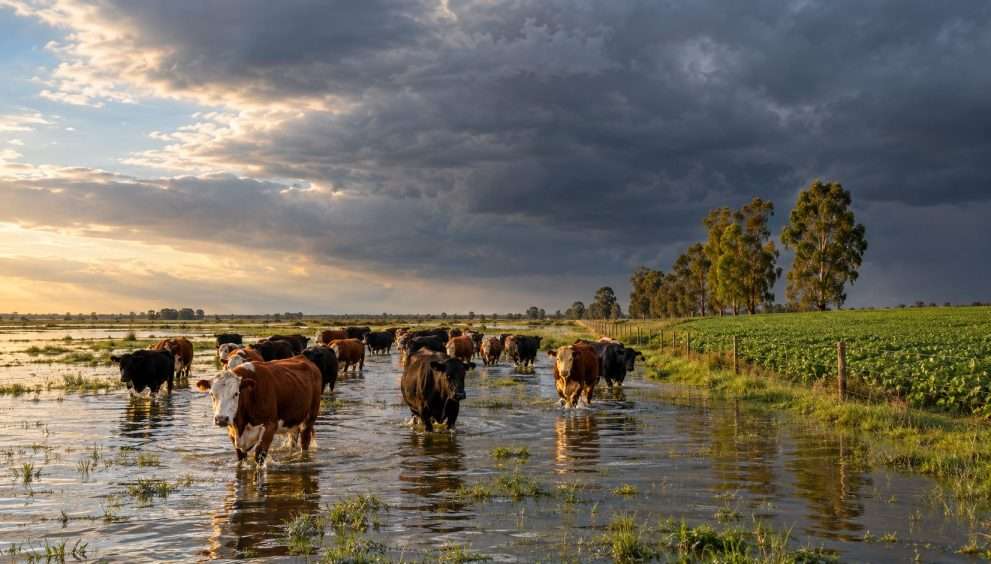
- Cattle in the Litoral. More than half a million cattle are being moved off the river islands of the Litoral. Grazing rents are rising, and forced sales are pushing cattle prices down (Letra P).
- Flood damage. The World Bank estimates that floods cost Argentina about USD 1 billion a year in destroyed assets.
- Exports by river. The Paraná waterway, which carries 80% of Argentina’s exports, faces disruption (Análisis Digital).
- Food prices. Fruit and vegetable prices are already rising. The IMF estimates that El Niño years lift global food prices by about 5% (Diario Uno).
Brazil: Inflation, Electricity and a Divided Harvest
Food Prices and Interest Rates
In Brazil, El Niño’s main economic effect is on prices. Rabobank estimates it will add 0.83 percentage points to IPCA consumer inflation within six months, mostly through food. The survey median puts the effect at 0.3 points for 2026 and 0.4 points for 2027 (Valor, Valor). Economists warn this could keep the Selic interest rate high for longer and slow the rest of the economy. One estimate is that a 5–10% fall in farm output would cut 0.3–0.8 points from GDP growth (R7).
The Harvest
The harvest outlook is still strong. Conab, Brazil’s national food supply agency, forecasts a record 367.1 Mt of grain, including 181.6 Mt of soybeans (Globo Rural). But the 2023–24 El Niño cut national soybean output by about 5%, and by 14% in Mato Grosso. MATOPIBA, the newer farming frontier, and the semi-arid Northeast are most exposed. The government has set aside R$ 1.33 billion for its El Niño response.
Electricity
Electricity is the other risk. Brazil gets most of its power from hydro, so drier catchments mean more expensive gas and oil-fired generation. That shows up quickly in power bills through the “tariff flag” surcharge (CNN Brasil).
Chile: An Already Weak Economy Takes Another Hit
Growth
Chile is facing El Niño with almost no growth to spare. Economists surveyed by the Central Bank expect only about 0.2% GDP growth in 2026 (Diario Financiero). Scotiabank thinks the economy could shrink by up to 0.5%. CEPAL estimates that an extreme El Niño could take about 0.5 points off Chile’s growth.
Central Bank of Chile research finds that El Niño mainly hurts the non-mining economy, especially manufacturing and fishing, and pushes up fruit and vegetable prices. For each 1°C rise in the El Niño index, fishing growth falls about 6.9 points, while electricity and water output rises about 2.9 points thanks to fuller reservoirs.
Fruit Exports
Fruit is where the cost will be felt most. Chile exported USD 9.3 billion of fruit in the most recent season (AgroLatam). González puts early cherry losses as high as 60%. He warns that hazelnuts are also at risk, and that summer heat will damage apples, pears and wine grapes. He also points to knock-on job losses in seasonal work, trucking and export logistics (Diario Financiero).
Mining and Storm Damage
Storms have also disrupted copper mining. Insurers estimate about USD 200 million in losses from the Santiago mudslides and storms alone.
Paraguay: Strong Growth, but Watch the Roads
Growth and the Soybean Crop
Paraguay goes into El Niño in good economic shape. The Central Bank of Paraguay raised its 2026 growth forecast to 5.0%, with agriculture growing 4.7% on a large soybean crop. Livestock output is expected to fall 4.5%, but that is because farmers are holding back breeding cows to rebuild herds, not because of El Niño.
The new soybean crop is forecast at 11.5–12 Mt. Local economists note that drought, not excess rain, has historically done the most damage to Paraguay’s output and inflation (La Nación Paraguay).
The Risks
The risks lie off the farm:
- Roads. Grain exporters’ association Capeco worries that unpaved rural roads will turn to mud and trap harvests on farms.
- Rivers. The Paraguay–Paraná waterway carries most of the country’s trade. Higher rivers can help barges but also disrupt ports.
- Hydropower. The Itaipú and Yacyretá dams should generate more power. However, Paraguay now uses more of its own share, leaving less surplus to sell to Brazil and Argentina (The Paraguay Post).
- 2027 outlook. Itaú sees heavy rain as a downside risk for the 2027 soybean harvest, construction and meat and vegetable prices (Itaú). The World Bank lists Paraguay, Argentina and Ecuador as potentially the most affected economies in the region (Última Hora).
Peru: The Region’s Biggest Loser
Growth and Inflation
Peru suffers most because the warming is right off its coast. Central bank president Julio Velarde estimates El Niño will cut growth by about 2 percentage points over 2026–27: 0.9 points this year and 1.1 points next. The bank has lowered its growth forecasts to 3.2% for 2026 and 3.0% for 2027 (Caretas, Infomercado). Inflation is expected to end 2026 at around 3.8–4.2%, above the 1–3% target.
Fishing and Farming
- Fishing: output is forecast to fall 30.7%. Scotiabank expects the anchovy catch to fall to about 1.5 Mt, the lowest since the last “extraordinary” El Niño in 1998 (Scotiabank Peru). The smaller catch also hits fishmeal and fish oil production.
- Agriculture: output is forecast to fall 1.5%, with coastal fruit, potatoes, rice and poultry worst affected. Mango output is already down about 20%.
- Northern coast: Tumbes, Piura, Lambayeque and La Libertad account for about a quarter of national farm output. Credicorp Capital puts total losses at about S/ 16 billion (RPP).
Construction, retail and services are still forecast to grow 4.7%, so the downturn is concentrated in the sectors most exposed to the weather (AmCham Peru).
Uruguay: Hurt by Rain, Helped by Hydropower
Exports and Growth
Uruguay depends on farming more than any other country covered here. Agribusiness makes up about 80% of its exports. In the 2015–16 El Niño, heavy rain cost rice growers about 160,000 tonnes, and goods exports fell 7.3% in 2016 (El Observador). The Rural Association of Uruguay says that the event cut well over a point from GDP (Infobae/EFE).
This time the country is still recovering from drought. Farm output fell 22.2% and GDP 0.5% in the second quarter of 2026 (Ámbito). The government has declared an institutional alert and is preparing a national contingency plan led by the president (MGAP).
Electricity Costs
Electricity is a bright spot. In past El Niño years, wetter conditions sharply cut UTE’s power supply costs. In 2007–14, power cost almost four times as much in La Niña years as in El Niño years. Supply costs recently averaged USD 65/MWh, against a 2020–25 average of USD 52 (El País Uruguay), so a wet year could bring real savings. Livestock farmers also gain from more grass.
Winners and Losers
| Likely winners | Likely losers |
|---|---|
| Argentina’s Central Bank reserves and Pampas grain growers | Peru’s fishing industry, fishmeal plants and northern coastal exporters |
| Paraguayan soybean growers and the Itaipú and Yacyretá dams | Chilean cherry, hazelnut and fruit exporters and their seasonal workers |
| Uruguay’s UTE and Chile’s hydropower generators | Rice growers in Uruguay, Corrientes and southern Brazil |
| Cattle producers on high ground with good grass | Cattle farmers on low ground and river islands in the Litoral |
| Sellers of durum wheat and maize, if prices rise as CEPAL expects (La Nación) | Brazilian consumers paying more for food and electricity |
What It Means for Land Buyers
The economic results above depend on where each farm sits. Land on higher ground, with secure water rights, good drainage and all-weather road access, keeps earning through floods and droughts. Low-lying river land, unirrigated orchards and farms on unpaved roads do not. The money also moves at different times: flood losses arrive now, while the grain income arrives with the 2027 harvest.
Before buying, ask the seller for:
- the farm’s flood record;
- its water rights;
- its road access in wet weather;
- how it performed in the 1997–98 and 2015–16 El Niño years.
Browse our Argentina farm listings, including water-secured vineyard land in Mendoza’s Uco Valley, or contact our team to discuss climate-resilient farmland across the Southern Cone.
This article is general information based on forecasts and estimates current at 27 October 2026. Economic and seasonal forecasts can change quickly, so check official sources before you make farming or investment decisions.

Founded in 2004, GTSA began as a single office in Buenos Aires. Since then, it has grown into a vibrant regional network, providing professional real estate marketing services to clients in AR, BR, CL, PY, PE, and UY.