


This post is also available in:  Español
If you plan to buy farmland in Uruguay as a foreigner, the good news is that the rules are stable, published and the same for locals and non-residents. What catches foreign farm buyers and family offices is the structure. Uruguay controls how rural land can be held, not who the investor is. This guide covers Ley 18.092, transfer tax (ITP), IRAE versus IMEBA, the wealth tax exemption for farms, and the escribano-led process from offer to title.
Can a Foreigner Buy Farmland in Uruguay?
Yes. There is no nationality or residency test for owning rural land. You can buy in your own name with a passport and a Uruguayan tax number (RUT), or through a local company. What matters is that you can identify the ultimate owners of any company holding the land.
Ley 18.092: Choosing the Ownership Structure
Ley 18.092 states that rural land and farming operations should be held by individuals, partnership-type companies (sociedades personales), agrarian companies, agrarian cooperatives and public entities. A sociedad anónima (SA) can only own farmland if all of its shares are nominative and held by individuals. Bearer-share SAs that held rural land had two years to convert their shares, or they were dissolved by law.
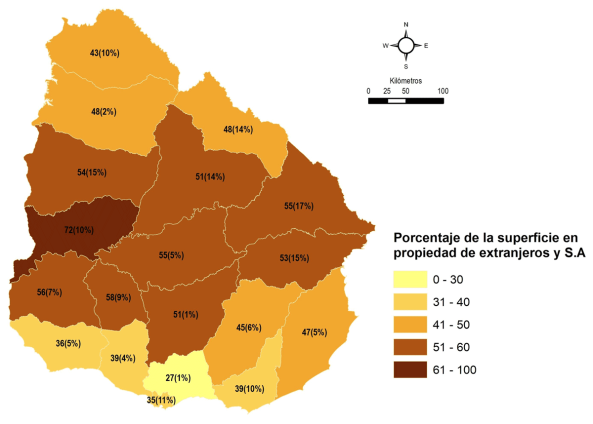
In practice, foreign buyers use one of four routes:
- Personal ownership. Simple and transparent, and it keeps the option of paying IMEBA (see below).
- SRL or otra sociedad personal. Limited liability with flexible taxation.
- SA with nominative shares owned by individuals. Familiar to family offices, but IRAE is compulsory.
- Executive authorisation. Under Decreto 225/007, funds, trusts, foreign branches and companies with corporate shareholders can hold land with prior approval from the Poder Ejecutivo, for example when the project is a development priority.
Family offices that hold assets through holding companies or trusts need to plan for that authorisation, or simplify their chain of ownership. A 2025 bill reported by KPMG would allow nominative shares to be held by other compliant entities, so check its status with your lawyer before you finalise the structure.
Transaction Costs: ITP 2% + 2%
The Impuesto a las Transmisiones Patrimoniales is 2% for the seller and 2% for the buyer. It is charged on the Catastro valor real, not the agreed price, and the lower of the two applies. On farmland, the cadastral value is usually well below market value, so the effective tax is often much less than 2%. The escribano withholds the ITP and pays it when the deed is signed.
As a guide, buyers also budget around 3% plus VAT for escribano fees, plus certificates and registration costs.
The Colonización Right of First Refusal
Before selling a farm of 500 hectares or more at CONEAT 100 (200 ha in Colonia, Florida, Maldonado and San José, and 100 ha in Canelones), the owner must first offer it to the Instituto Nacional de Colonización at the same price and terms. The INC has 20 business days to respond. If the seller skips this step, the sale is void, and a fine applies. For large farms, build this window into your timeline.
Operating Taxes: IRAE vs IMEBA
Farm income is subject to IRAE, Uruguay’s corporate income tax (25%). Some producers can choose IMEBA instead. IMEBA is charged on the first sale of farm products, at rates between 0.1% and 2.5% depending on the product, plus small surcharges.
IRAE is compulsory for SAs, permanent establishments of non-residents, trusts, businesses with revenue above UI 2.5 million (about US$400,000), and farms larger than 1,250 ha CONEAT 100. Individuals and personal companies below those limits can choose between the two. IMEBA is simpler and often cheaper for cattle and grazing operations. IRAE suits buyers making heavy investments that generate deductible costs.
Impuesto al Patrimonio: The Agricultural Exemption
Assets used in farming are exempt from wealth tax if their value stays below UI 12 million. That value is the land at fiscal value plus a notional 40% for livestock and equipment, about US$1.98 million as of mid-2026. The exemption does not apply to bearer-share entities, foreign legal entities, or entities whose nominative shares are not held by individuals. Related holdings are added together. Above the threshold, companies pay 1.5% (or 0.75% if total assets are below UI 30 million). Larger family-office purchases should model this from the start.
The Escribano Process and Promesa de Compraventa
In Uruguay, the escribano (a public notary) does the work that title lawyers, conveyancers and settlement agents do elsewhere. A typical farm purchase follows these steps:
- Offer and reserva. You sign a reservation agreement and pay a deposit.
- Due diligence. The escribano reviews at least 30 years of title history, liens, Catastro and CONEAT data, water rights, leases, environmental restrictions and DICOSE livestock records.
- INC offer, where the farm is large enough to require it.
- Promesa de compraventa. A binding promise to sell. Once registered, it gives the buyer a property right that can be enforced against later sales or mortgages.
- Escritura. You sign the deed, pay the balance, and pay the ITP. The deed is then registered at the Registro de la Propiedad.
Typical Timeline
| Stage | Indicative time |
| Reserva to completed due diligence | 2–4 weeks |
| INC response (if required) | Up to 20 business days |
| Promesa to escritura | 30–90 days |
| Company setup or executive authorisation | 1–6 months (start early) |
Uruguay Farms Available Through GTSA
Rankings for this topic are dominated by guides and government pages, but few of them show farms actually for sale. Gateway to South America markets working Uruguayan farms to international buyers, including these. We can introduce you to off-market opportunities, vetted escribanos and tax advisers and help you compare ownership structures before you make an offer.
This article is general information, not legal or tax advice. Always confirm current rules with a Uruguayan escribano and accountant before you buy.

Hector is a highly regarded agricultural consultant with exceptional interpersonal skills and extensive farming knowledge. His empathy fosters strong client relationships. Innovative and adaptable, he excels in various work settings. Hector’s expertise is bolstered by advanced degrees, including a PhD from New Zealand.

