According to the Rosario Stock Exchange (BCR), this income recorded in 2024 represented 13% more than in 2023.
Despite a slight drop in the volumes shipped, in 2024, Argentina achieved US$1,186 billion in exports of peanuts and their derivatives, 13% more than the previous year. In addition, the 2024/25 planting reached 473,000 hectares, a historic record. This was reported by the Rosario Stock Exchange (BCR).
It is worth remembering that the country is one of the world’s largest exporters of peanuts and that in the last 15 years, with India, it has been alternating first and second place in the international ranking of international suppliers of this oilseed. “From the 2022/23 campaign onwards, Argentina holds second place on the podium, with exported volumes very close to those of India,” the stock exchange indicated.

In 2024, the top five buyers of Argentine peanut complex exports were the Netherlands (36%), the United Kingdom (9%), Poland (6%), Russia (6%) and Australia (4%).
According to the BCR, of the total amount exported, some
US$949 million were exports of shelled peanuts, which includes peanuts with skin and blanched peanuts. In second place, another US$145 million corresponded to products that include roasted peanuts and peanut butter. Finally, US$84 million came from shipments of peanut oil and US$9 million from pellets and expellers.
“The increase in export prices of these products played a fundamental role, since, in volume, exports in 2024 totaled 730,030 tons, which represents a decrease of -1.2% compared to the previous year,” they described.
The price increase, they said, was due to production problems in key countries and increased demand, which reduced global stocks for the 2023/24 campaign to the lowest level in eight years. “A relevant case is that of Brazil, the world’s fifth largest exporter of peanuts, which, with the combination of the worst drought in years and subsequent floods in important producing regions, suffered a 7% drop in its production. There were also cuts in production in India, the world leader in exports,” they noted.
In 2024, the top five buyers of Argentine peanut complex exports were the Netherlands (36%), the United Kingdom (9%), Poland (6%), Russia (6%) and Australia (4%), according to data from Indec. Argentina would have exported to 51 countries, with the European Union representing 73% of the total.
For the Rosario agency, one aspect worth highlighting is that, as of decree 38/2025, published in the official bulletin on January 27, 2025, the Export Duties (DEX) on blanched peanuts, both whole and broken, in packages less than or equal to two kilos, were reduced from 3% to 0%. The withholdings applied to solid waste from peanut crushing (cakes, expellers, pellets, cake flour, etc.) were also reduced from 5% to 0% , “which is of great relevance and an additional incentive for the industrialization of peanuts and the export of products with higher added value.”
Record area sown in the 2024/25 campaign
Along these lines, they indicated that Argentina not only registers records on the demand side, but also surpasses itself year after year on the production front . According to the report of the Ministry of Agriculture, in the 2024/25 campaign, approximately 473,976 hectares of peanuts were planted in the country, exceeding the plantings of the previous campaign by 9% and registering an absolute record of area.
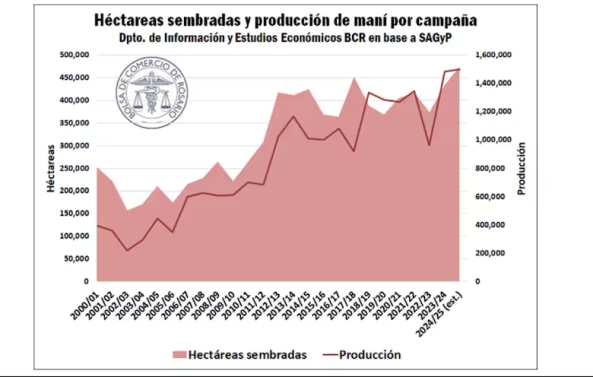
“As of February 6, planting had already been completed nationwide. With this planted area and projecting slightly lower yields than those of the previous campaign, given the initial context of water shortage,
A record production of 1.5 million tonnes can be projected, expressed in peanuts per box (that is, including the shell that contains it),” they stated.
Regarding the evolution of crops, according to SAGyP,
in the province of Córdoba the crop shows a generally favorable state. “In the areas that received rain recently, the plants have experienced a partial recovery, although new rainfall is still required to mitigate the impact on yields, especially in the areas most affected by the drought. Currently, peanuts are in the grain filling phase. Regarding health, fungicide applications and monitoring are being carried out to detect the presence of spider mites, whose population, so far, remains below the damage threshold. In the province of La Pampa, the plots are evolving in good conditions and are close to starting the flowering stage. For its part, in the NOA region, the peanut crop is showing adequate development and continues in full vegetative growth,” they concluded.
Source: La Nacion

Founded in 2004, GTSA began as a single office in Buenos Aires. Since then, it has grown into a vibrant regional network, providing professional real estate marketing services to clients in AR, BR, CL, PY, PE, and UY.