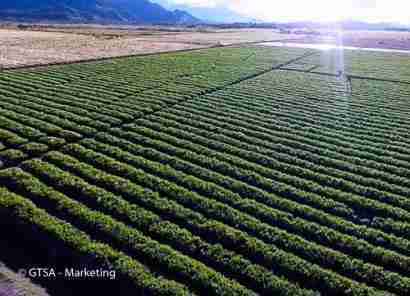
San Martin is located in the northeastern Peruvian territory, occupying areas of high and low forest, with a territorial extension of 51,253.31 Km2, which represents 4% of the national territory in the eastern flank of the Andean relief, in the northern and centralsector between The parallels 5o 15` and 8o 25`15“ of south latitude from the Ecuador. Its territory occupies the middle sector of the valley formed by the Huallaga River, which makes it an area with large endowments of natural resources. The geographical boundaries are:
- North: Departments of Amazonas and Loreto.
- South: Ancash and Huánuco Departments between meridians 75o 45 ‘0
” and 77o 24’22” west longitude from Greenwich Meridian. - By the East: Department of Loreto.
- In the West: Departments of Liberty and Amazonas.
Excellent climate for doing business and sustainable private investments”
Political division
The San Martin region consists of 10 provinces, with Moyobamba as its capital. Tarapoto has the most districts, followed by Lamas and Picota.
Climate
The region’s climate is predominantly warm and humid, with only one rainy season corresponding to the southern winter. The irregularity of its morphology results in a heterogeneity of climates that vary with altitude, rainfall, and the time of year.
The climate is dry and warm in low sectors and hills, with temperatures averaging 26 ° C and rainfall of 800 to 1,000 m.m. Annual concerts in January – April (Bellavista and Picota); In the high hill sectors, the climate is humid and semi-warm, with average annual temperatures of 24 ° C and rainfall exceeding 1,500 m.m. Annual (Lamas) in the area corresponding to the eastern slope towards the Amazonian plain; The precipitation reaches 3,500 m.m. (Pongo 1 of Caynarachi.) .
Within the hydrographic system, the region is confirmed by the main tributaries of the Huallaga river, including the Mayo, Sisa, and Huayabamba rivers. It also contains gaps, which are mostly shallow, high-temperature, and semicircular. The lagoons, like the Shango, Tipishca, and Sauce, stand out for their ichthyologic richness.
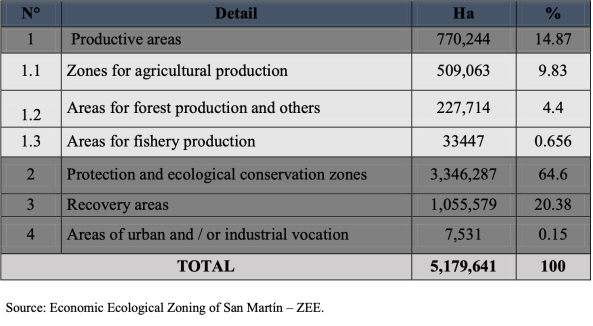
Land Use
Access
By Road:
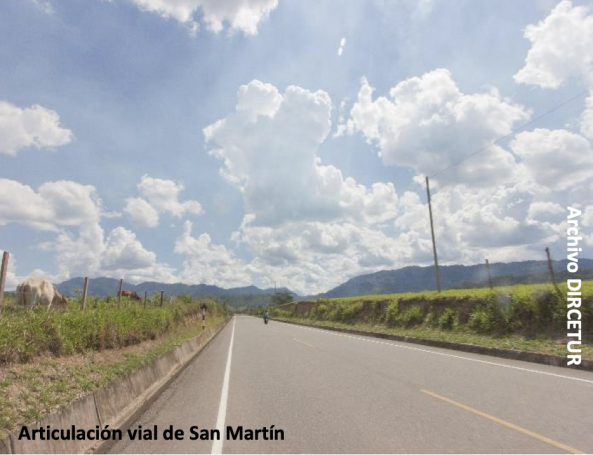
Tarapoto: 1445 Km by Panamericana Norte and Fernando Belaunde Terry or Marginal de la Selva roads (28 hours by bus).Lima-Pacasmayo-Cajamarca-Balsas-Leymebamba – diversion to Chachapoyas, Pedro Ruiz: 1547 Km. by Panamericana Norte and Fernando Belaunde Ferry roads (22 hours by car).
Regular flights from Lima (1 hour and 15 minutes) and from Iquitos (45 minutes) to Tarapoto.
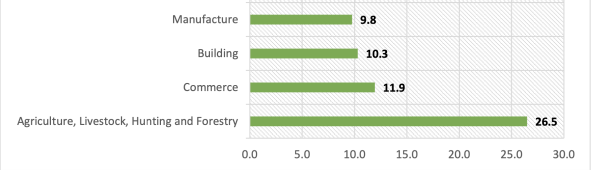
Production
Exports
The economic dynamics of the San Martin region are influenced by agricultural exports to European, US, Asian and Latin American markets. The main export is coffee, which represents 76%, with organic coffee being the most demanded in the international market. Cocoa is the second product exported by the region and represents 16%, followed by other products such as (
This Peruvian region is becoming increasingly attractive, as agricultural companies want to guarantee customers all-year-round availability of their crops by looking for places with different harvesting seasons than their existing ones. The region of San Martin, with year-round warm temperatures and water availability, offers this complementarity to
56.90% of the exporting companies in the San Martin region are micro enterprises, 34.48% are represented by medium and small companies, and only 8.62% are large companies.
San Martín’s exports are mainly sent to the United States (15%), Italy (15%), Germany (11%), the Netherlands (10%), and Chile.
Foriegn Investors Rights
Non-discriminatory treatment vis-à-vis the national.
Freedom of trade and industry, and freedom of export and import.
Free remittance of profits or dividends.
The right to use the most favourable exchange rate available in the market for foreign exchange transactions that it requires.
Free re-export of its capital.
Unrestricted access to internal credit.
Free hiring of technology and remittance of royalties.
Freedom to acquire shares owned by national investors.
Freedom to contract abroad, safe for your investment.
The possibility of signing legal stability agreements with the state for their investment in the country.
Opportunity
One of the challenges for agricultural investors in this region is obtaining sufficient land area to justify the costs of producing high-value crops.
If you are looking, we can help.
Contact the Gateway to South America team to learn about the best investment opportunities in the region. The company is a benchmark for foreign investors wishing to invest in Argentina, Brazil, Chile, Paraguay, Peru, and Uruguay and provides expert advice on property acquisition.
www.gatewaytosouthamerica.com

Founded in 2004, GTSA began as a single office in Buenos Aires. Since then, it has grown into a vibrant regional network, providing professional real estate marketing services to clients in AR, BR, CL, PY, PE, and UY.