The project, undertaken by Pan American Energy and its partners, aims to position the country as a key supplier of liquefied gas in a more competitive international market. The first floating unit is expected to arrive in 2027 and will operate from the San Matías Gulf.
Oil company Pan American Energy (PAE) announced today that it has made the final investment decision (FID) to install a second liquefied natural gas (LNG) production vessel. This confirms a total estimated investment of more than US$15 billion, which will be executed over the project’s 20-year operation and will encompass the entire value chain. This initiative will also enable new investments in the development of Vaca Muerta.
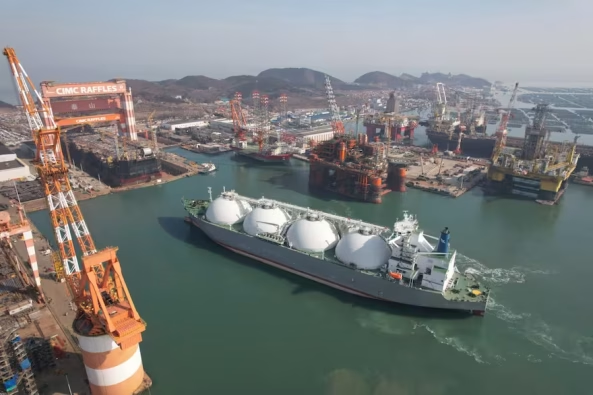
With the arrival of the two LNG tankers, Argentina will have the capacity to export 27 million cubic meters of natural gas per day (m³/d) within three years, equivalent to 18% of its current production (150 million m³/d).
The announcement was made by Southern Energy (SESA), the company created by PAE and Golar LNG, which also includes YPF (25%), Pampa Energía (20%), Harbour Energy (15%), and Golar LNG (10%). PAE owns 30%.
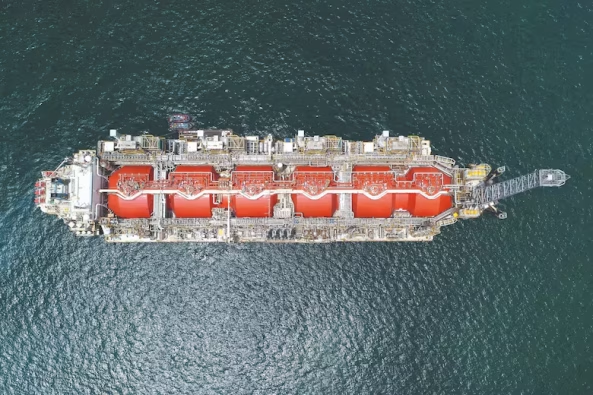
The first vessel, named Hilli Episeyo, currently in Kribi, Cameroon, is scheduled to arrive in Argentina in early 2027. Pan American Energy
The company projects an investment of more than US$3.2 billion for the first phase of the project (2024-2031), while for the second phase (2032-2035), it estimates nearly US$2.8 billion. In total, the investment for both phases would be approximately US$6 billion.
“Over the project’s 20-year lifespan, the total planned investment is over US$15 billion across the entire value chain, which will also enable additional development investments in Vaca Muerta and a higher level of upstream activity,” the company confirmed in a statement.
The second vessel, designated as MKII, is currently under construction at a shipyard in China and is expected to arrive in the country in 2028. Its commercial operation is expected to begin at the end of that year. It will have a production capacity of 3.5 million tonnes per year (MTPA) of LNG, equivalent to approximately 16 million m³/d of natural gas.
The first vessel, named Hilli Episeyo, currently in Kribi, Cameroon, is scheduled to arrive in Argentina in early 2027. It will be capable of producing 2.45 MTPA of LNG, equivalent to 11.5 million m³/d of gas. Together, the two vessels will produce a total of 6 MTPA of LNG.
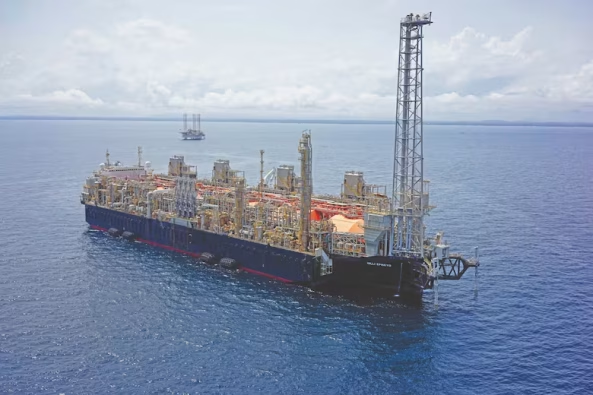
The “Hilli Episeyo” has a production capacity of 2.4 million tons of LNG per year, equivalent to 11.5 million cubic meters of natural gas per day. Nearly 300 meters long, it was built in 1975 and converted for gas processing in 2017. Pan American Energy
While the final value of exports will depend on the evolution of international LNG prices, it is estimated that between the start of operations in 2027 and 2035, foreign sales will exceed USD 20 billion. “This will represent an effective way to monetise the country’s vast gas resources and a genuine source of foreign currency for the country’s external balance,” SESA stated.
The two ships will be located in the San Matías Gulf, between the cities of Sierra Grande and San Antonio Oeste, in the province of Río Negro. An oil export terminal will also be built at the same location.
The choice of Río Negro was determined by its anchoring depth of approximately 35 meters, which allows for safe operation without draft restrictions.
In terms of job creation, the project is expected to generate 1,900 direct and indirect jobs, predominantly local, during the construction phase, according to the statement.
The project has already been approved by the Large Investment Incentive Regime (RIGI), has received a certificate of authorisation to freely export LNG for 30 years, and has received approval for the environmental impact study from the province of Río Negro.
Other LNG projects
Following Russia’s invasion of Ukraine, which disrupted the global energy market, countries are seeking to diversify their energy sources and secure supplies. In this new scenario, Argentina has the opportunity to export the surplus gas generated by Vaca Muerta. The LNG market is highly competitive, and only a few countries possess the necessary infrastructure to liquefy gas. Today, the main exporters are Australia, Qatar, the United States, Russia, and Malaysia.
YPF originally planned to build a liquefaction plant in Sierra Grande, but the plan was later converted to installing floating vessels. However, the ultimate goal remains: for Argentina to export 30 MTPA of LNG, equivalent to 141 million m³/d of natural gas, by 2030.
In addition to the two vessels already confirmed, YPF is working on the construction of four more LNG vessels in China. Two are being developed in partnership with Italy’s Eni, and the other two with Anglo-Dutch Shell.
SESA’s project envisions the first two floating liquefaction terminals being able to operate year-round, starting in 2028, which requires the development of the necessary transportation infrastructure for this mode of operation.
Therefore, to materialise all these projects, it will be necessary to build two new gas pipelines from the Neuquén basin to Río Negro: one similar to the Perito Moreno pipeline (formerly called Presidente Néstor Kirchner), 36 inches, and another even larger, 42 inches, which has never been built in the country.
Source: La Nacion

Founded in 2004, GTSA began as a single office in Buenos Aires. Since then, it has grown into a vibrant regional network, providing professional real estate marketing services to clients in AR, BR, CL, PY, PE, and UY.