This post is also available in:  Español
 Português
“Raising sails and sailing the impetuous waves, the ancestors of the Chinese nation opened the Maritime Silk Road between the East and the West more than 2,000 years ago,” Chinese President Xi Jinping said in his speech in Lima.
It was around 7 p.m. on November 14, 2024. Sitting next to his Peruvian counterpart, Dina Boluarte, Xi added that, more than 500 years ago, the Incas had “managed to build the great road that crossed the Andes Mountains from North to South”.
In Chancay, some 80 kilometres from the Peruvian capital, dozens of Chinese and Peruvian officials followed his words via videoconference as they lined up in front of giant blue containers bearing the Cosco Shipping brand.
“Today, the port of Chancay becomes the starting point of the great Inca road of a new era, from Chancay to Shanghai,” Xi said. With those words, he inaugurated the Chancay Multipurpose Port Terminal.
Project Overview
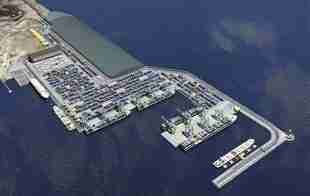
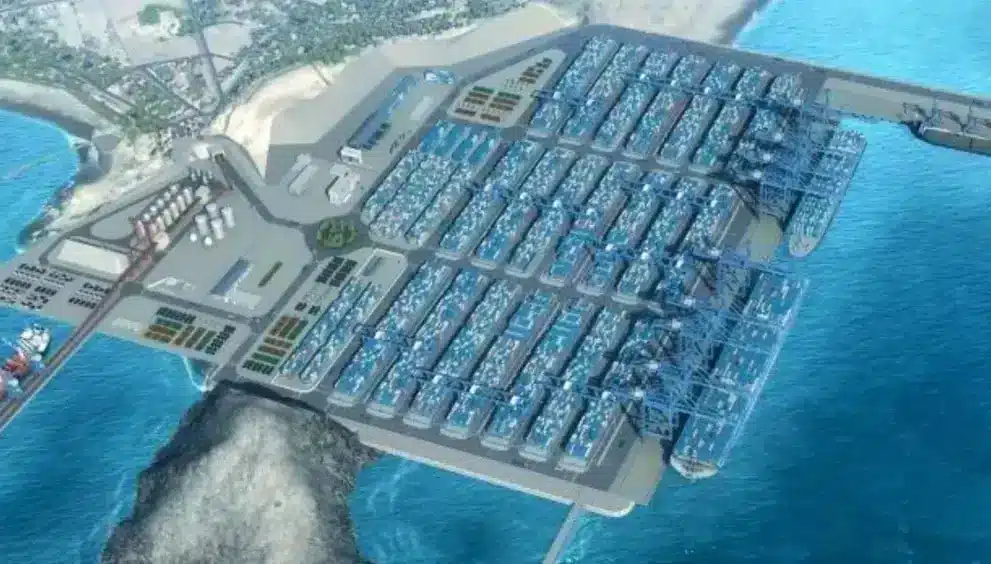
The Chancay Multipurpose Port Terminal is a massive $3.6 billion project funded under China’s Belt and Road Initiative (BRI). The port is designed to receive containerised, general, and rolling cargo and accommodate the world’s largest container ships. When completed, it is expected to cover 992 hectares and handle up to one million twenty-foot equivalent units (TEUs) annually.
The project is being developed in two stages:
- The first stage, costing $1.3 billion, includes an operating zone with four berths (two for containers and two multipurpose), an administrative and logistics complex, and a 1.8-kilometre tunnel connecting the operating zone and the logistics complex.
- The second stage will complete the operating zone by building 11 more docks, for a total of 15 berth.
Strategic Importance
Experts say the port is expected to become a regional hub that will consolidate trade between Asia and South America7. According to economist Jorge Vega, professor at the Pontificia Universidad Católica del Perú (PUCP), this is due to the port’s “location, size, modern technology, and contact with global shipping networks.” The travel time between South America and China will fall from 36 days to 24 days.
The Chancay port aims to reduce congestion and logistics costs at Peru’s main port, the Lima–Callao hub, while establishing itself as a critical gateway to Asia and a global commercial hub for cargo redistribution1. It is expected to generate $4.5 billion annually and create 8,000 jobs.
Ownership and Development
China Ocean Shipping (Group) Company or COSCO now owns 60% of the port, with Volcan Compañía Minera S.A.A., a local Peruvian company, owning the remaining 40%. The main contractor is Consorcio CHECSAC-CCCC4TH, a subsidiary of China Harbour Engineering Company Limited (CHEC) and China Communications Construction Company Limited (CCCC).
Environmental and Economic Impact
As of November 2024, the Port of Chancay has not been authorized by the Peruvian state to handle loose minerals, as such cargo requires a stricter environmental impact assessment and compliance with environmental regulations1. It is expected that the main cargo from South America will be agricultural products.
The port’s contribution to the Peruvian economy is projected to be 0.3% of GDP in its first phase, expected to reach 0.9% by 2025.
Geopolitical Implications
The development of the Chancay port has raised concerns in US policymaking circles over Chinese influence in a region traditionally seen as its backyard. Some US officials have suggested that products going through Chancay should be subject to additional tariffs, and there are concerns about the potential for the port to host Chinese naval warships in the future.
In response to these concerns, Peru has been playing a balancing role. Its recent agreement with the United States to establish a spaceport in Talara demonstrates Peru’s efforts to maintain relationships with China and the US.
Contact the Gateway to South America team to discover the best investment opportunities in the region. This company sets the standard for foreign investors aiming to invest in Argentina, Brazil, Chile, Paraguay, Peru, and Uruguay, providing expert guidance on property acquisition and investment tours.
Argentina – Brazil – Chile – Paraguay – Peru – Uruguay
The Gateway Team – When You’re Serious About Property
www.gatewaytosouthamerica.com

Founded in 2004, GTSA began as a single office in Buenos Aires. Since then, it has grown into a vibrant regional network, providing professional real estate marketing services to clients in AR, BR, CL, PY, PE, and UY.