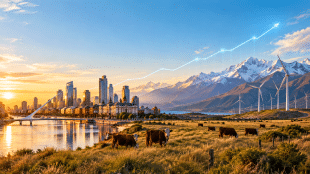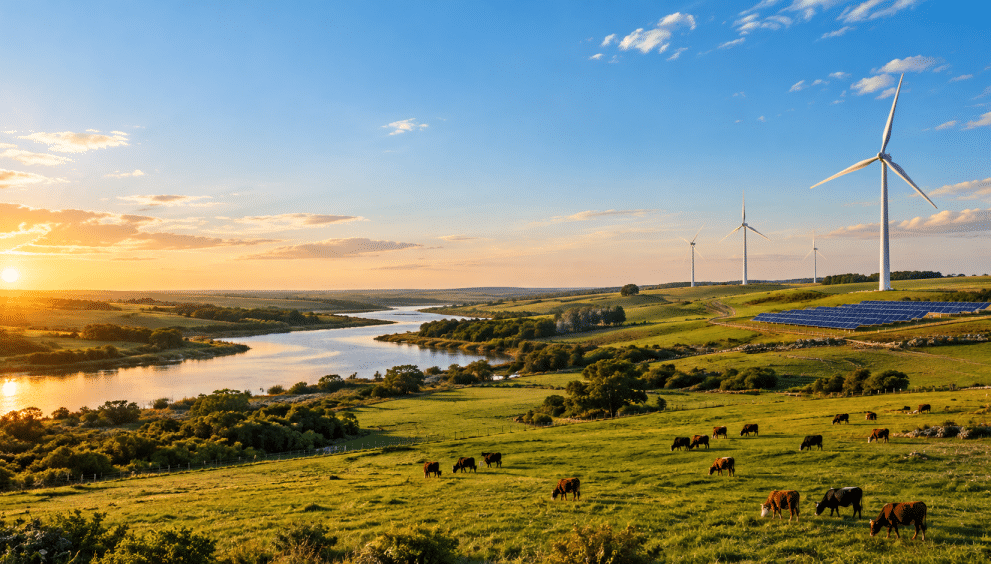
Uruguay has about 3.5 million people and no oil, gas or coal. It now runs on almost entirely renewable electricity and has built a model of sustainable development that larger economies still struggle to match. Its results come from steady policy, private investment and practical choices, not from luck.
From Fuel Importer to Clean Power Leader
Until the mid-2000s, Uruguay imported most of its fuel, and droughts that cut hydropower forced expensive oil purchases. The country chose renewables mainly for energy independence. Ramón Méndez Galain, who led the transition, said it was “absolutely a conscious decision” because Uruguay has no fossil fuel reserves of its own.
The results are striking. By 2024, 99% of Uruguay’s electricity came from renewables: hydro 42%, wind 28%, biomass 26% and solar 3%. Power generation has moved from a roughly 50% fossil fuel mix to about 2%. Uruguay also exported 2,026 GWh of electricity in 2024. It has gone from importer to net exporter, supplying neighbours Argentina and Brazil.
A Plan Backed by Every Party
Uruguay’s long-term transition plan had support across the entire political system for more than a decade. That consistency gave investors confidence. More than US$8 billion has been invested since 2010, largely by private actors, in wind, biomass, solar and grid infrastructure. The money replaced recurring fossil fuel import bills with long-lived domestic assets.
The economic benefits followed. Energy costs fell from roughly $10 to $5 per unit as the fossil share dropped. GDP grew while power-sector emissions fell sharply, and drought years no longer caused billion-dollar fuel import shocks. The analysis of Uruguay’s experience concludes that rapid decarbonisation is an institutional challenge more than a technology one.
Beyond Electricity
Uruguay is now in a second phase, aimed at transport and industry. Transport is the largest source of energy-sector CO₂ emissions. The country offers tax reductions on electric vehicle purchases and lower permit costs for electric taxis. It has also published a green hydrogen roadmap. Bloomberg figures cited by the World Economic Forum suggest hydrogen exports could generate $2.1 billion in revenue and up to 34,000 jobs by 2040.
Uruguay is also a top-ten global beef exporter, and cattle account for 78% of its methane and 63% of its nitrous oxide emissions. It has responded with efficiency gains and natural pasture management. In 2021 it became the first South American nation to export carbon-neutral beef, certified by LSQA and supported by pastures and native forest conservation. It has also joined the Global Methane Pledge. Its updated climate pledge commits to cutting emissions intensity per unit of GDP by 25%, methane by 57% and nitrous oxide by 48%.
Environmental Leadership and Social Strength
Uruguay has been at the forefront of efforts to limit plastic pollution and end mercury poisoning. It also launched the Montevideo Environmental Law Programme, which helps other nations develop environmental legislation. That gives a country with only 0.04% of global emissions an outsized voice in global environmental policy.
Sustainability here rests on a strong social base. Consistent investment in education, healthcare and welfare has produced one of the region’s largest middle classes and lowest levels of inequality. Uruguay’s overshoot day falls in mid-December, which puts it among the most sustainable countries on the planet. Uruguay also ranks first in Latin America on Numbeo’s quality of life index.
What It Means for Investors and Residents
For businesses, the clean grid is a competitive advantage. Operations in Uruguay are close to carbon-neutral by default on electricity, which matters as European and US carbon rules tighten. The grid reaches 99.8% of households and has a redundant transmission network that secures supply. Stable institutions and clean energy have also drawn large companies and a growing green start-up ecosystem.
For rural and agricultural property buyers, the beef and pasture story matters. Natural grasslands, native forest protection and carbon-neutral certification add value to land and to the products it produces.
Lessons from Uruguay
Uruguay shows that a small country can lead when it sets a clear goal, keeps policy stable across governments, and lets private capital do the building. It cut costs, gained energy security, created jobs and lowered emissions at the same time. Challenges remain, including transport, fuels beyond electricity and agricultural methane. But Uruguay has already shown that a clean energy economy can also be a prosperous one.

Hector is a highly regarded agricultural consultant with exceptional interpersonal skills and extensive farming knowledge. His empathy fosters strong client relationships. Innovative and adaptable, he excels in various work settings. Hector’s expertise is bolstered by advanced degrees, including a PhD from New Zealand.