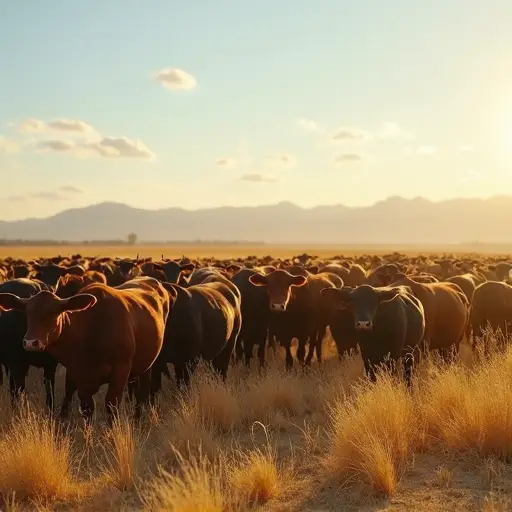
The beef cattle industry remains one of Argentina’s most significant economic drivers, combining historical importance with strong current performance. According to a recent study conducted by the Rosario Board of Trade (BCR), the sector is projected to inject approximately US$20.32 billion into the Argentine economy in 2025 through expenditures and investments required to sustain production capacity. This represents one of the largest financial mobilisations in the country’s agribusiness sector.
The updated analysis, based on earlier work by the Regional Consortium for Agricultural Experimentation (CREA) and the Liaison Committee, highlights the scale of investment consistent with the strategic relevance of a sector that produces over 3 million tons of beef annually. Beef production remains a vital component of national output, export earnings, and rural employment.
Argentina remains the world’s leading consumer of beef per capita and ranks fifth globally among beef exporters. In 2024, the beef and leather complex constituted the country’s sixth-largest export sector, illustrating its dual significance for both domestic consumption and international trade performance.
Composition of Sectoral Expenditure
BCR economists Franco Ramseyer, Emilce Terré, and Julio Calzada estimated that total sector expenditure for 2025 will be distributed as follows:
- US$9.95 billion for herd replacement
- US$8.59 billion for direct and indirect operational expenses
- US$1.02 billion for durable goods acquisitions
- US$755 million for marketing and logistics
The study notes that maintaining the nation’s cattle stock of approximately 51.6 million head requires constant reinvestment throughout the production chain. This reinvestment supports not only domestic consumption but also Argentina’s competitive position in global markets.
Breakdown of Key Cost Components
Direct production costs are projected at US$4.12 billion, primarily composed of feed (73 per cent of total costs), followed by labour and veterinary services. Indirect expenses are expected to reach US$4.48 billion, including administration, infrastructure maintenance, technical management, and land leases or grazing rights, valued at US$1.4 billion. Marketing and distribution expenditures total US$755 million, with sales commissions accounting for the largest portion and livestock transportation costs making up the remainder.
Investment in durable goods—a reflection of capital formation within the sector—is forecast at US$1.02 billion, covering machinery, infrastructure improvements, and vehicle renewals. Herd replacement, the largest single category at US$9.95 billion, accounts for the cyclical renewal of breeding and finishing animals, ensuring continuity and growth across production segments.
Sectoral Impact
The BCR report concludes that the scale of resource mobilisation in the beef industry underscores its macroeconomic influence. With deep linkages to rural employment, industrial processing, and export activity, the cattle sector remains a cornerstone of Argentina’s economic structure. Its stability and growth capacity continue to shape both regional development and the country’s global agricultural reputation.

Founded in 2004, GTSA began as a single office in Buenos Aires. Since then, it has grown into a vibrant regional network, providing professional real estate marketing services to clients in AR, BR, CL, PY, PE, and UY.