


This post is also available in:  Español
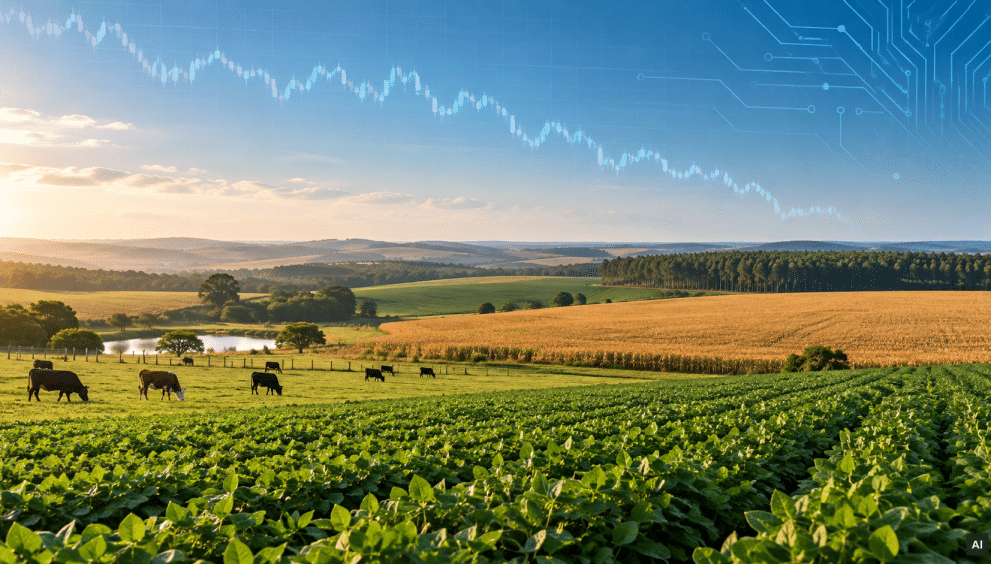
As investors question how much further artificial-intelligence stocks can rise, productive farmland is attracting renewed attention. For Latin America, that could create an opportunity: international capital seeking diversification may increasingly look towards agricultural assets that generate income from food, livestock and timber rather than expectations of future technology profits.
But an AI correction would not automatically send farmland prices higher. The outcome would depend on whether investors make an orderly shift into real assets or face a broader financial crisis that restricts credit and forces asset sales.
The strongest case for farmland is not that technology must fail. It is that a well-balanced investment portfolio should not depend on technology succeeding indefinitely.
Why major investors are looking beyond technology
J.P. Morgan Asset Management has explicitly linked renewed interest in farmland and forestry to financial markets increasingly driven by technology, AI and a relatively small group of large companies. Its argument is diversification: agricultural and forestry investments have historically shown low correlations with public markets, while generating returns through production, leasing and long-term appreciation.
That is not a prediction that an AI crash is inevitable. Nor is it evidence that banks are abandoning technology. It is an acknowledgement that concentrated portfolios carry risks, even when the underlying technology has genuine economic value.
Farmland offers a different set of income drivers. A farm’s performance depends on factors such as productive capacity, management, weather, agricultural prices and operating costs. A forest continues growing regardless of whether a technology company meets its quarterly earnings forecast. These assets have their own risks, but those risks are not identical to those of an AI-heavy equity portfolio.
From a market-oriented perspective, moving some capital into agriculture is not inherently a problem. It can be a rational decision to exchange part of an investment portfolio’s exposure to financial expectations for ownership of productive assets.
Why Latin America belongs in the discussion
Tether: digital wealth moves into South American agriculture
One of the clearest examples of digital-finance capital moving into productive agriculture is Tether, the group behind USDT, the world’s largest stablecoin. In April 2025, Tether Investments announced the successful acquisition of a 70% controlling stake in Adecoagro, an agricultural and renewable-energy business operating in Argentina, Brazil and Uruguay. The investment followed its initial $100 million purchase of a 9.8% stake in September 2024.
At the time of the transaction, Adecoagro’s agricultural footprint encompassed approximately 210,400 hectares across the three countries. Its activities included crop production, rice, dairy, sugar, ethanol and energy. Through its controlling shareholding, Tether gained substantial exposure to South American farmland and agricultural production, including operations in Argentina. That is different from directly purchasing every hectare in the company’s operating footprint.
The significance extends beyond cryptocurrency. A business associated with digital money chose to invest in assets whose value rests on land, food, energy and operational performance. Tether described the acquisition as part of a broader expansion beyond digital finance into real-world infrastructure—not as a response to an anticipated AI crash.
That distinction strengthens the argument for farmland diversification. Investors do not need to abandon technology to recognise the value of productive land. Digital businesses and agricultural assets can sit alongside one another, combining exposure to innovation with businesses serving enduring physical needs.
Importantly, this should not be presented as USDT being “backed by farmland”. Tether states that its proprietary investments in agriculture and other sectors are funded from excess capital and profits and are segregated from the reserves backing its issued tokens.
For Latin America, the transaction illustrates an opportunity to attract capital generated in entirely different industries. The market-oriented test is what happens next: whether investment improves production, infrastructure and operating efficiency, rather than merely raising the price of land.
A separate Argentine acquisition needs careful attribution
There is also a more recent development worth distinguishing. Reports in November 2026 describe the sale of the Benetton family’s Argentine landholding companies, covering more than 900,000 hectares, to an investor group led by Adecoagro chief executive Mariano Bosch. Those reports identify the buyers as partners and executives acting separately—not Adecoagro itself. The purchase should therefore not be described as an additional Tether farmland acquisition without further confirmation of Tether’s participation.
A debate centred on British farmland overlooks the opportunities available in South America.
Uruguay, Argentina, Brazil and Paraguay form an important food-exporting region. For investors considering agricultural diversification, the relevant question is not simply where land appears inexpensive, but where productive potential can be combined with workable operating conditions, secure ownership and access to customers. Uruguay XXI identifies the region’s food-production advantages and documents the participation of domestic investors, foreign buyers and investment funds in Uruguay’s rural land market.
However, investors should resist treating Latin America as a single farmland market. Foreign-buyer rules, title systems, restricted areas and the legal rights attached to a property vary between countries and individual parcels. A registered freehold interest, a concession, a company shareholding and a possessory claim are not interchangeable investments.
The investment case therefore begins with productivity, not a regional label or a prediction about Wall Street.
A property should be assessed as an agricultural business: what it can produce, what that production costs, how reliably it can reach a market and what income remains after expenses.
Uruguay illustrates the importance of investment certainty
Uruguay provides a useful example of how the investment environment can support the agricultural opportunity.
Its investment framework provides equal treatment for domestic and foreign investment, alongside freedom to repatriate capital and profits. Uruguay XXI identifies agribusiness, logistics and forestry among the activities attracting international investment. These general investment protections should nevertheless be distinguished from the specific legal and corporate requirements applying to an individual rural acquisition.
The country also illustrates the connection between land ownership and an established export economy. Its leading goods exports in 2024 included cellulose, beef, soybeans and dairy products—products rooted directly in the performance of its agricultural and forestry sectors.
For a long-term investor, that connection matters. The attraction is not merely owning hectares. It is owning an asset that participates in an operating supply chain.
Yet a favourable investment framework does not eliminate agricultural risk. Uruguay’s severe 2023 drought drove soybean yields to historic lows and sharply reduced agricultural exports. Secure ownership cannot guarantee rainfall or a profitable harvest.
Would an AI crash actually lift farmland prices?
There are at least three plausible outcomes. These are scenarios, not forecasts.
1. An orderly rotation into productive assets
If investors reduce technology exposure while financial markets remain functional, some capital could move into farmland and forestry.
That would fit the diversification argument outlined by J.P. Morgan. Additional demand could support valuations where investors identify reliable income, credible management and acceptable legal risk. However, an institutional interest in agriculture does not mean every farm—or every country—would benefit equally.
2. A wider financial shock
A severe crash could initially produce the opposite result.
Investors facing losses might prioritise cash rather than new acquisitions. More cautious lenders could make transactions harder to finance. A broader economic slowdown could also weaken agricultural earnings through lower commodity demand.
Under that scenario, farmland could remain productive while its sale price stagnated or declined. Low historical correlation with equities should not be confused with immunity from financial stress.
3. A gradual reallocation without a crash
An AI collapse is not required for agricultural investment to grow.
Investors may simply decide that portfolios dominated by a single investment theme need balancing. J.P. Morgan’s discussion of natural capital describes precisely this search for assets with different underlying drivers.
For Latin American landowners and agricultural businesses, that quieter process could prove more useful than a sudden speculative rush: capital arriving gradually, with time to evaluate properties and structure durable operating partnerships.
Outside capital can strengthen farming
Critics often describe institutional investment in farmland as “financialisation”, implying that the arrival of investment funds necessarily damages agriculture.
That conclusion is too broad.
There is a legitimate distinction between buying land primarily for resale and investing in a farm to improve its productive performance. The latter can involve better water infrastructure, pasture development, machinery, storage, management and market access.
The more useful policy question is therefore not whether an owner is a family, a partnership or a pension fund. It is whether ownership supports a viable business, respects lawful rights and leaves the land capable of producing over the long term.
There are also alternatives to an outright sale. Leasing, operating partnerships and other negotiated arrangements can allow landowners and agricultural operators to combine land, expertise and capital. Whether those arrangements benefit both parties depends on their terms—not on an assumption that outside investment is either automatically beneficial or automatically exploitative.
A pro-enterprise approach should favour competition and voluntary agreements, rather than subsidies or preferential treatment for politically connected buyers.
Higher prices are not an unqualified success
A market-friendly analysis should still recognise the consequences of rising land values.
Existing owners may welcome stronger prices. An expanding farmer or new entrant may see the same increase as a higher barrier to ownership. If purchase prices rise faster than sustainable farm earnings, buyers can end up relying on future appreciation rather than operating income.
That is a reason for valuation discipline, not an argument against private property.
Investors should distinguish between:
• Land that supports its price through realistic agricultural earnings.
• Land where identifiable improvements could increase productive capacity.
• Land priced mainly on the expectation that another buyer will pay more.
Savills itself has cautioned that farmland appreciation can slow when weaker demand, economic pressures and greater supply affect the market. Agricultural land does not move upwards in a straight line.
Food and timber should underpin the valuation
Carbon, conservation and biodiversity revenues can broaden the income available from some properties. J.P. Morgan identifies these alongside more established returns from crops, timber and leasing.
But additional revenue streams should be assessed commercially, not accepted because they carry fashionable terminology.
A prudent underwriting approach is to establish the property’s value from proven production and legally dependable income, then evaluate environmental-credit opportunities separately. Prospective credits should not be treated as equivalent to an established agricultural lease or a demonstrated operating history.
The same principle applies to AI-related demand: an investment thesis should work without needing either a technology crash or an optimistic carbon-price forecast.
The policy opportunity for Latin America
A market-oriented response to greater interest in farmland would focus on making productive investment easier and speculation less politically privileged.
That means prioritising:
• Clear, enforceable property rights, including existing lawful community and Indigenous rights.
• Transparent ownership records and dependable transaction procedures.
• Predictable taxation and regulation.
• Competitive access to finance.
• Better transport, storage and agricultural infrastructure.
• Environmental rules that protect soil and water without rewarding political connections.
The objective should not be to maximise land prices. It should be to increase the productivity, resilience and competitiveness of agriculture.
An AI downturn could direct more attention towards Latin American farmland, but attention alone creates no lasting agricultural wealth. The opportunity lies in turning investment into better farms and stronger businesses.
The case for ownership of productive land does not require an argument against technology—or against capital. It requires confidence that secure rights, sound management and disciplined investment can create value beyond the latest stock-market cycle.

The New Zealander has a distinguished career of over 30 years in 7 countries, specializing in South American real estate, agriculture, and commercial matters. As the founder of Gateway to South America, he is known for his discretion, expertise, and experience in representing active clients in the region. His extensive knowledge of the market has positioned him as a leading authority and trusted advisor.

