


Argentina is projected to be one of the fastest‑growing economies in Spanish‑speaking Latin America in 2025, with forecasts around 4.5–5.5% GDP growth and still-solid figures for 2026. This performance is closely linked to Javier Milei’s aggressive pro‑market reform agenda, centred on fiscal adjustment, deregulation, tax reform and the removal of bureaucratic barriers to investment.
Milei’s reform pillars
Milei’s government has implemented a sharp fiscal consolidation, equivalent to a double‑digit share of GDP, mainly through spending cuts. It freezes or rollbacks of many subsidies, which have moved the primary balance into surplus and substantially reduced the need for monetary financing. At the same time, a sweeping deregulation and “chainsaw” of bureaucracy (including the Ley Bases and an omnibus deregulation decree) has aimed to liberalise prices, reduce state intervention in key sectors, simplify permits and shrink the federal public sector.
On the tax side, the administration has pursued a multi‑year reform that lowers corporate income tax rates, offers accelerated depreciation and better loss carry‑forward rules, and gradually reduces some distortionary levies, with the explicit goal of shifting the tax burden away from production and investment. A parallel agenda seeks to dismantle capital controls over time and ease export and import restrictions, with the expectation that a more open, rules‑based environment will attract foreign direct investment in energy (Vaca Muerta), mining (lithium), agribusiness and infrastructure.
Growth forecasts and regional context
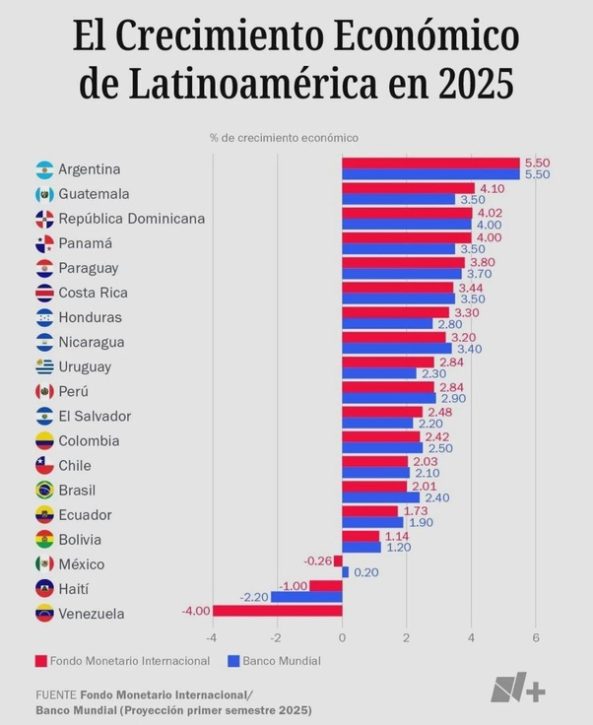
According to the World Bank and the IMF, after a contraction of around 1.8% in 2024, Argentina’s economy is expected to rebound strongly in 2025, with growth projections in the 4.5–5.5% range, clearly above the Latin American and Caribbean average of roughly 2.1–2.4%. ECLAC’s 2025 Economic Survey highlights that South America’s modest regional expansion is driven in significant part by Argentina’s recovery, alongside improvements in a handful of other countries, while many economies in the region remain stuck in low‑growth dynamics.
Recent updates note some trimming of Argentina’s growth forecast (for example, from 5.5% down to around 4.6%), but even the revised figures still place the country among the top performers in the region and the fastest‑growing of the larger Latin American economies. For 2026, multilateral institutions point to continued expansion near 4%, contingent on maintaining policy continuity, further disinflation, and sustained investor confidence.
How reforms link to growth
Analyses by international organisations and independent researchers argue that the combination of expenditure cuts, deregulation and a clearer, more predictable rules-based framework has sharply improved Argentina’s fiscal position and reduced macroeconomic imbalances, which, in turn, have lowered country risk and helped normalise interest rates and inflation. As monthly inflation decreases and expectations stabilise, real wages begin to recover, and credit markets slowly unlock, supporting a rebound in private consumption and investment after the initial adjustment shock.
From a theoretical standpoint, Milei’s agenda fits the classic “work, saving and investment” logic of liberal capitalism: less distortionary taxation, leaner government and fewer regulatory barriers are meant to raise expected returns on productive activity and attract both domestic and foreign capital. While there are significant social and political challenges—particularly the short‑term increase in poverty and unemployment associated with the abrupt adjustment—the core macroeconomic bet is that, over several years, these pro‑market reforms will deliver higher, more sustained growth than the regional average, validating the “math” behind the model.
Interested in South American Properties
Contact the Gateway to South America team to discover the best investment opportunities in the region. This company sets the standard for foreign investors aiming to invest in Argentina, Brazil, Chile, Paraguay, Peru, and Uruguay, providing expert guidance on property acquisition and investment tours.
Argentina – Brazil – Chile – Paraguay – Peru – Uruguay
The Gateway Team – When You’re Serious About Property
www.gatewaytosouthamerica.com

Founded in 2004, GTSA began as a single office in Buenos Aires. Since then, it has grown into a vibrant regional network, providing professional real estate marketing services to clients in AR, BR, CL, PY, PE, and UY.

