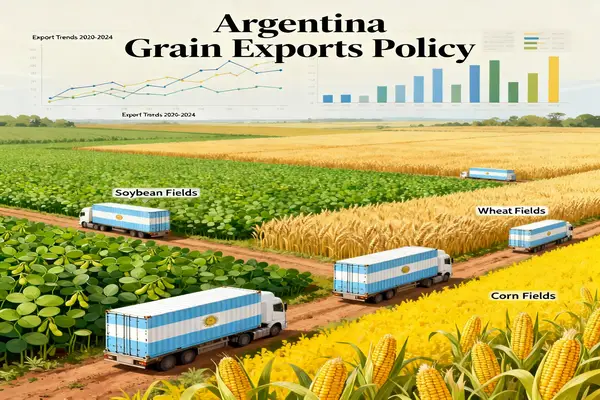
The Argentine government has temporarily eliminated withholding taxes on grain exports until October 31, representing a significant but short-term relief for the country’s most important export sector amid mounting economic pressures and upcoming elections.
Background and Economic Context
Argentina’s agricultural sector has been burdened by export withholding taxes (retenciones) that have remained among the world’s highest. According to the World Bank, only Argentina, Russia, Kazakhstan, the Ivory Coast, and the Solomon Islands maintain withholding taxes above 0.5% of GDP. These taxes have historically served as a major revenue source for the federal government, but they’ve also been criticised as a key factor hindering agricultural investment and production growth.
The measure announced by presidential spokesman Manuel Adorni on Monday morning affects all major crops, including soybeans, corn, wheat, sunflowers, and other grains. The timing is strategic, extending five days beyond the October 26 national elections, with the explicit goal of generating increased dollar inflows during a critical period for Argentina’s foreign currency reserves.
Recent Policy Changes
This elimination builds on previous reductions implemented in July through Decree 526, which had already lowered rates significantly. Soybean withholding taxes dropped from 33% to 26%, while corn and sorghum rates fell from 12% to 9.5%. Sunflower taxes decreased from 7.5% to 5%, and wheat and barley remained at 9.5%. These changes represented the most substantial reduction in agricultural export taxes in years.
Economic Pressures Driving the Decision
The Central Bank’s precarious reserve situation has intensified pressure for dollar inflows. Last week alone, the institution sold $1.1 billion amid currency tensions, highlighting the urgent need for foreign currency. The agricultural sector typically contributes 7 out of every 10 dollars entering Argentina and represents 19% of registered employment, making it crucial for macroeconomic stability.
Broader Implications
This temporary measure occurs against the backdrop of Argentina’s long-standing agricultural competitiveness challenges. While Argentina exported 89.7 million tons of grains and subproducts in 2024, Brazil exported 153.14 million tons during the same period. The tax burden has been identified as a primary factor in this performance gap, with countries like Brazil achieving 257% GDP growth over the past thirty years compared to Argentina’s 56%.
The government’s expectation is that agricultural producers will accelerate export sales during this tax-free period, providing immediate relief to foreign exchange pressures while demonstrating the sector’s potential when freed from excessive taxation.

Founded in 2004, GTSA began as a single office in Buenos Aires. Since then, it has grown into a vibrant regional network, providing professional real estate marketing services to clients in AR, BR, CL, PY, PE, and UY.