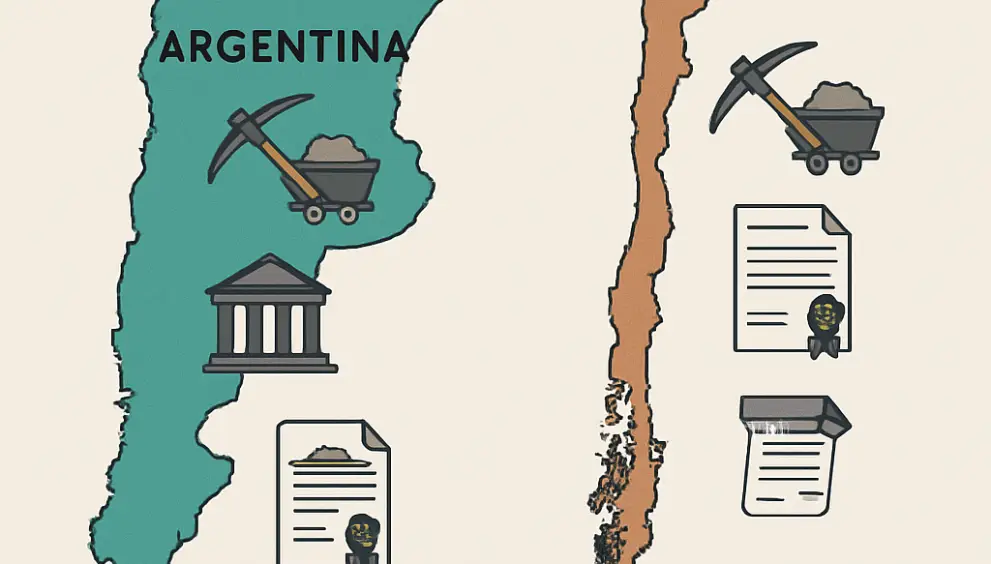
Mineral rights in both Argentina and Chile are ultimately owned by the state—provinces in Argentina, and the national government in Chile—but private entities, both local and foreign, can acquire concessions to explore and exploit mineral resources through regulated processes in each country. There are important differences in how rights are granted, managed, and protected, as summarised below.
Argentina: Provincial Ownership and Concessions
- Mineral resources are owned by the provinces, not the federal government. Provincial authorities grant exploration and exploitation concessions, often through a regulated process based on the National Mining Code.
- Individuals or legal entities, including foreign investors, can acquire mining concessions by applying to provincial authorities, without nationality restrictions.
- Once granted, concessions are perpetual if conditions (taxes, investments, exploitation) are met.
- Concessions allow holders to freely dispose of minerals extracted within their area.
- Surface property and underground mineral rights are legally distinct; surface owners do not automatically own mineral rights beneath the land.
- Environmental and procedural regulations vary by province, complicating nationwide operations for investors.
Chile: State Ownership and Judicial Concessions
- The state is the absolute, exclusive, and permanent owner of all mineral resources except some non-concessionable substances (e.g., hydrocarbons, lithium in some contexts).
- Individuals and entities may obtain mining concessions, which are real property rights independent of surface land ownership (“split estates”).
- The granting of mining concessions requires a formal judicial process; rights become effective only after being registered by a judge in the local mining registry.
- Mining concessions allow for exploration and exploitation—exploration concessions are limited in time, while exploitation concessions are perpetual as long as obligations are met.
- Surface owners are obliged to allow access for mineral exploitation, but are entitled to compensation.
- Chilean mining law provides strong protection of property rights over mining concessions, especially for foreign investors.
Key Comparisons (Markdown Table)
| Feature | Argentina | Chile |
|---|---|---|
| Ultimate owner of minerals | Provinces | State |
| Concession process | Provincial authority, administrative | Judicial resolution, registration |
| Foreign ownership | Allowed, no restrictions | Allowed, strong protection |
| Duration of concessions | Perpetual if obligations met | Perpetual (exploitation), limited (exploration) |
| Surface vs. mineral rights | Legally distinct; mineral estate dominates | Split estate; mineral estate dominates |
| Environmental regulation | Varies by province | National laws and amendments |
Notable Recent Developments
- Chile recently passed significant mining royalty reforms, introducing new tax components for operators based on output and profitability.
- Certain Argentine provinces restrict or ban specific mineral processing chemicals (e.g., cyanide).
Both jurisdictions support robust foreign participation in mining, but require careful navigation of local frameworks and evolving regulations.

Founded in 2004, GTSA began as a single office in Buenos Aires. Since then, it has grown into a vibrant regional network, providing professional real estate marketing services to clients in AR, BR, CL, PY, PE, and UY.