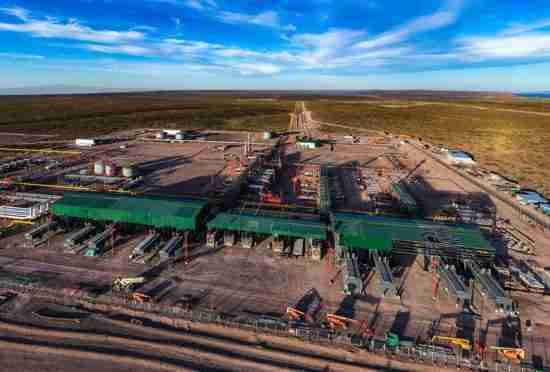
A little over a decade after the exploitation of unconventional hydrocarbon deposits began, Añelo and other small towns experienced rapid development and triggered the generation of new needs.
Around 110 kilometres separate the city of Neuquén from Añelo, one of the closest towns to unconventional hydrocarbon deposits and the industry’s base. But the trip is not simple: a caravan of trucks and private vehicles can block routes 7 and 67, and the trip can take up to three hours. In addition, according to statistics, between one and seven accidents are recorded daily on this so-called “oil corridor,” which has been completely destroyed.
Añelo has an estimated population of 10,000 people, representing a growth of 334% compared to the 2,300 registered in the 2010 Census. In addition, 15,000 people live there non-permanently, and another 100,000 travel there daily in 20,000 vehicles. According to projections, the population will rise to 40,000 in the next five years and 200,000 in the next decade.
To date, the lack of infrastructure has become evident: 5,000 houses are under construction, and another 7,000 are expected. The public services infrastructure—which includes sewers, gas networks, schools, and hospitals, for example—is falling short. Due to the lack of funds, many projects are financed with contributions from companies involved in the hydrocarbon project. According to official estimates, around 400 companies operate in the municipality, together with small local producers.
“More traditional industries, such as mining or those focused on conventional hydrocarbon exploitation, carry out exploration that takes years of planning; things happen at a manageable speed.
On the contrary, with fracking, that did not happen. Neuquén is saturated,” said Rodolfo Fiadone, a logistics consultant. He added: “So, today we find ourselves with a critical situation in Añelo and Rincón de los Sauces, small towns until then dedicated to providing some services to the conventional oil industry and small fruit fields in the so-called Alto Valle.
Many men left their agricultural tasks attracted by higher salaries—which led to a lack of labour—and others arrived from different locations, first alone and then with their families. The population grew exponentially, generating the need to bring food from other places. In addition, companies began to set up hotels and facilities for employees where they could.
It was a volatile and chaotic growth; ancient houses are mixed with hotels and buildings built with stacked containers.”
For the specialist, these localities did not have an urban regulatory system that anticipated growth.“We face a strong province of Neuquén but with weak municipal governments and little institutionality. The solution will come through the coordinated work of the municipalities to organize growth based on the interests of the population, companies and communes. Companies alone cannot solve this; they must be guided by the State,” he said.
Map of unconventional players
Vaca Muerta was consolidated into an export project and sparked a wave of investments in 2010 when the first well was drilled. Although the geological formation was discovered by the American Charles Edwin Weaver around 1930 when he was carrying out field studies for Standard Oil of California, it was not until 2011 that YPF confirmed the investigations and two years later, data from the Energy Information Administration reaffirmed its potential: these indicate that Argentina has reserves of 27 billion barrels of shale oil – the fourth largest in the world – and 802 trillion cubic feet of shale gas – the second largest behind China.
Vaca Muerta is the most important oil formation, with around 38% gas and 60% oil.
At that time, the oil industry faced technological and economic restrictions that did not allow it to exploit unconventional reservoirs. The source rock in which they are housed has low porosity and permeability, so the oil and gas are trapped and cannot move within or escape from the formation. The combination of two old techniques made their exploitation possible – hydraulic fracturing and horizontal drilling – which requires constant and greater investments.
This is because most of the hydrocarbons available in the wells are extracted in the first year of exploitation: to generate sustainable production over time, it is necessary to maintain constant levels of drilling,
According to industry sources, the country has hydrocarbon resources to supply the local demand for gas and oil for more than a century. However, they consider that a significant modification of the current regulatory environment is required to achieve a substantial leap in investment levels and, thus, guarantee the rapid valorization of the resources. The energy transition, which involves the progressive abandonment of fossil fuels, marks the expiration date of the business. According to the Chamber of Exploration and Production of Hydrocarbons, the investments required for gas and oil production were estimated at US$5 billion in 2023, while projections climb to US$13 billion by 2030.
YPF has the largest presence in Vaca Muerta, with around 40% of the concession area. The map of private companies includes Tecpetrol, Pan American Energy, Pluspetrol, Shell, and Phoenix, among others.
“When we started Fortín de Piedra, in 18 months, we went from producing 0 to more than 17 MMm3/day of gas, 13% of the gas generated in the country then. We carried out that project together with more than 1,000 Argentine companies that make up our value chain, which demonstrates the capacity of the Argentine industrial and services sector.
Going forward, and given the scale and speed with which the development of Vaca Muerta can grow, we have to continue working on the competitiveness of the chain, with the incorporation of technology, training and process improvement, so that we can transform resources into wealth,” said Guillermo Murphy, vice president of Supply Chain at Tecpetrol. Since 2017, the company has invested more than US$2.4 million in drilling tasks and another US$1.2 billion in developing facilities and works.
Real state development
Given this scenario, the real estate business stood out. One of those that set its sights on this region, focusing on senior executives in the industry, was the Altamonte Hotel Group, owner of the Howard Johnson and Days Inn brands in Argentina. In 2018, the company began construction of a new hotel in Cinco Saltos, located in the Province of Río Negro and 30 minutes from the Neuquén airport. And after having been paralyzed during the pandemic, its opening was scheduled for the end of this year.
The hotel has 66 en-suite rooms, a presidential room, a restaurant, a spa, a swimming pool, and a gym. It also has an auditorium for meetings, with a capacity of 250 people. “Howard Johnson relies on two market segments: tourists and, above all, corporates. Due to its proximity to Añelo, there is already contact with companies that are thinking about buying rooms and reserving a room for meetings and events as soon as the work is inaugurated,” said Alberto Albamonte, head of the group. Currently, two other high-end hotels in the area serve as a base for oil companies: Howard Johnson by Wyndham, located near the province’s airport, and the Hotel Casino Magic.
From Puerto Madero to Añelo
Another real estate developer betting more heavily on Vaca Muerta is Issel Kiperszmid. He is one of the investors who played a key role in the explosion that Puerto Madero experienced twenty years ago. His company, Dypsa, is responsible for projects such as the Renoir towers and docks 7 and 14.
Kiperszmid opened the largest hotel in Añelo, the Wenelen, four years ago, with an investment of US$15 million, and is now moving forward with an expansion to add 28 new apartments. In parallel, he also has another property in the city centre, where he plans to build a complex of apartments, which will be serviced by the Wenelen Hotel services.
“Wenelen is the most important hotel in Añelo, and we are 100% targeting corporate travellers. Basically, we have three categories of clients. The first is the people who work on the wells, who generally rent the apartments for two, three or four people for longer stays. A second group is the senior staff of the oil companies, which is an increasingly broad target because shale wells have a much higher proportion of engineers than traditional wells. And a third category of clients are the employees and technicians of companies that provide specific services to the oil companies and stay for a shorter period,” explained Kiperszmid.
The existence of a significant demand for real estate projects is beyond dispute. However, they recognize that carrying out the work is not a simple task in the sector. “The expectations and demands are very high, but the logistics are still complicated.
It is tough to build at a high altitude here; you don’t have materials, and it is difficult to find specialized labour. This is one of the reasons that explains why, for the moment, the level of family settlements is still very low, and the large housing volume is occupied by oil company workers,” acknowledged the Neuquén businessman César Paredes, owner of the real estate services company Inversión Vaca Muerta, based in Añelo.
Towards an extension of the value chain
Another of the main players is Alberta, a company created by the Blancoamor Group, a household products retail chain founded almost 40 years ago in Neuquén. “We started to sell the retailer’s items to companies for farms and hotels. But we saw that companies had a demand for many services that are not their core business, that they could not cover, and they needed trustworthy people. So, we started taking on different activities around our business and created Alberta,” said Federico Kreplak, president of the firm.
Along these lines, Alberta has made progress in developing housing solutions for oil and gas companies. The business includes the development of housing modules and the comprehensive maintenance of houses, trailers, and camps, and it employs around 60 people to clean, maintain, and perform equipment and security tasks. Today, the company operates 2,500 beds in Añelo in four complexes. Later, the company also focused directly on real estate development by constructing hostels and houses for the industry. And to this was the planning of Añelo Nuevo, a new city attached to the old one .
Alberta’s third business vertical focuses on logistics services – storage and transportation. Under this umbrella, the company built three complexes. On the one hand, the Ecoparque Alberta business park, the first stage of which was inaugurated at the end of last year, with an investment of US$2 million; by the end of the work, a total outlay of US$6 million is projected. On the other hand, there is the Alberta Neuquén Logistics Park, consisting of one hectare, for which an injection of US$1.5 million has been defined. To these is added a third industrial park, located in the city of Añelo, under construction.
The Consumption Exception
The La Anónima supermarket chain was another one that bet on the area. Created more than 100 years ago in Patagonia, the company already had a presence in Plaza Huincul, Cutral Co and Rincón de los Sauces, towns related to the conventional exploitation of hydrocarbons, among many other places in the province. After the Vaca Muerta phenomenon, it opened the doors of its first store in Añelo in 2017. “When we decided to enter, this was a tiny town. We bet on the Vaca Muerta project, which, day by day, is becoming a reality. Whenever we see that there is development and communities with the potential to grow, we seek to accompany the growth,” said Nicolás Braun, CEO. The need that it sought to cover was clear: at that time, according to official data, the interannual growth rate of food products in supermarkets was around 38%.
According to Braun, the Añelo store has two particularities. “A significant part of the purchases are made directly by companies that supply supplies to provide services to their employees. These are large sales, so we make deliveries in sealed packages,” Braun said. He added: “Now, people have started to settle with their families, which from the point of view of our business is much healthier; we have gone from serving not only the person who works in the oil industry but also their circle.”
On the other hand, the executive pointed out that the strong demand for labour by the industry implies a substantial staff turnover. “It is difficult to assemble the staff that the branch requires. For this reason, we installed a self-service checkout line to speed up and provide better service at checkout,” he said. La Anónima has planned openings in San Patricio del Chañar, in Gral. Fernández Oro, and in Centenario. “The impact of Vaca Muerta spills over into all these cities.”
The supermarket was set up, with an investment of nearly $55 million, in the area of the first shopping centre in Añelo, developed by the firm Ingeniería SIMA on a nine-hectare plot of land. Banco Galicia was another of the companies that set up shop in this shopping centre. The store – equipped with ATMs and self-service terminals – was inaugurated in 2016, along with another one located in Cutral Co, with an outlay of $30 million. Two years later, Banco Galicia also landed in the Metropolitan Industrial Park by injecting nearly $8 million.
Laura PonassoAlfredo Sainz Translated from La Nacion

Founded in 2004, GTSA began as a single office in Buenos Aires. Since then, it has grown into a vibrant regional network, providing professional real estate marketing services to clients in AR, BR, CL, PY, PE, and UY.