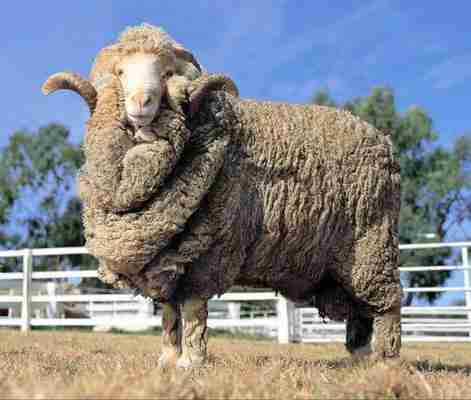
With one hand, breeder Sebastian Saura holds the head of a sheep, and with the other, in a matter of minutes, he shears the animal down to its tender pink skin.
It is the first phase of a trip that will transport wool from Uruguay — one of the world’s top exporters of textile fibre — to Germany for use in the seats of luxury cars.
At this farm in central Uruguay, 17 workers spend three days shearing 2,600 sheep. They do it in the southern hemisphere’s springtime, before the summer heat sets in.
Some workers are tasked with entering a pen to capture the animals, which can weigh up to 50 kilograms (110 pounds), and then lugging them into a hangar where they are held down to shed their fleece.
“There is a real team spirit. We are very well organised because that is the only way to work,” said Saura, 22, working alongside his father, Roberto, who has been shearing sheep for 36 years.
Between Brazil and Argentina, Uruguay boasts a population of 3.5 million and nearly twice as many sheep — 6.6 million.
To sell all that wool, it has to look abroad. Of its annual production of nearly 30 million kilos, only one per cent is absorbed by the local market.
Low maritime freight costs are a big help.
“It is more expensive to bring wool from Salto in northern Uruguay than it is to send it to China,” said Facundo Ruvira, commercial director of Tops Fray Marcos, the country’s biggest plant for washing and combing wool — a practice abandoned decades ago in western Europe.
– World’s third biggest clean wool exporter –
Indeed, Uruguay is one of the last countries in the world that exports large amounts of washed and combed wool, unlike Australia and New Zealand, which ship it in its raw, unprocessed form.
In this particular added-value segment, Uruguay is the world’s third-largest exporter with a market share of 12 per cent, surpassed only by China and the Czech Republic.
While the country’s thinnest wool, such as Merino, is used in the luxury fashion industry, thicker wool from a breed of sheep called Corriedale — the most common kind in Uruguay — is used in the seats of high-end German cars and in aircraft.
Ruvira said his top client for the past 20 or 30 years has been the Austrian group Schoeller, which supplies the auto industry and is very demanding about the wool it buys.
At his plant, Ruvira demonstrates how wool is separated into long- and short-strand varieties, washed in both cold and hot water, with soap and then without, before being combed and packaged for shipping.
The process adds value and also creates jobs for 150 people at the Tops Fray Marcos plant in Libertad, located west of the capital, Montevideo.
The wool then travels by freighter for 25 days before reaching Germany, where it is transformed into carpets or fabric for BMW and Mercedes-Benz cars, said Ruvira.
– Sheep treated well –
In Hard, western Austria, the owner of Schoeller, Kurt Haselwander, praises what he calls the subtlety of Uruguayan wool — he buys 800 tons of it annually — and its elasticity and softness.
Another thing that makes it stand out compared to Australian or New Zealand wool is that sheep are treated better in Uruguay than in those countries, he says.
To wit: sheep in Uruguay, unlike in those other two competitors, are not subjected to mulesing, in which a piece of skin is sliced from around the anus of a sheep without anesthetic.
This is done to produce a scar-free area, free from wool, fecal, and urine stains, and thus prevent what is known as flystrike, where flies lay their eggs on the skin of sheep, and these hatch into larvae that feed on the sheep’s tissue.
Schoeller uses the wool to make sweaters, socks, and other garments, as well as upholstery for luxury car seats and the seats in business class on planes, because it does not wear down as quickly as other kinds of wool, Haselwander said.
In cars, wool is used because it is safer — it does not burn like synthetic materials, said Carlos Piovani, who oversees shearing at the Uruguayan Wool Secretariat.
Synthetic materials derived from oil are the primary competitors of wool, and the sector has suffered significantly as a result, both here and worldwide.
“Thirty years ago, we had 20 million sheep,” said Piovani.
However, Uruguay is counting on a recent rise in wool prices and takes pride in its higher quality.
Uruguay exports wool for USD 250-300 million a year, the same as 30 years ago, but with a lot less of it, said Piovani.
Source: Yahoo News
Contact the Gateway to South America team to learn about the best investment opportunities in the region. The company serves as a benchmark for foreign investors seeking to invest in Argentina, Brazil, Chile, Paraguay, Peru, and Uruguay, offering expert advice on property acquisition and providing investment tours.
The Gateway Team – When You are Serious About Property
www.gatewaytosouthamerica.com

Founded in 2004, GTSA began as a single office in Buenos Aires. Since then, it has grown into a vibrant regional network, providing professional real estate marketing services to clients in AR, BR, CL, PY, PE, and UY.