


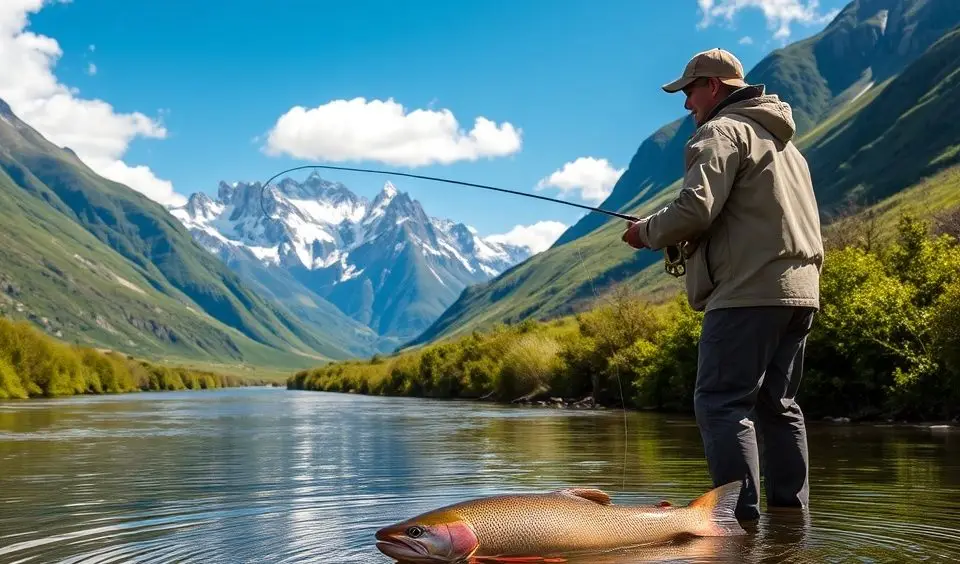
Argentina offers some of the world’s best fly fishing. Whether you’re a beginner or an experienced angler; looking to fish in lakes, brooks or rivers, for salmon, trout, or Dorado; wading, from a boat or from the shore; staying in five-star lodges and Estancias, or camping and cooking your catch on a fire beneath the stars, Argentina has it all, and with the further advantage that the fishing season runs during the northern hemisphere winter, from mid-November until mid-April.
Buenos Aires province offers the most accessible fishing, with day trips possible from the capital, a one-hour motorboat journey up the River Plate. The best fly fishing in the region, though, can be found further north, casting for the Golden Dorado from a boat on the Parana River Delta. This hefty (between five and twenty-five pounds), native, yellow-tinged, salmon-like, freshwater fish has a powerful jaw and large teeth and is known as the Tigre del Rio (River Tiger) because of the aggression and vigour with which it fights when hooked. The Paraná Delta is enormous, covering around 6,000 square miles, so you will need a guide.
Further north, in Corrientes province, the Ibera Marshes National Reserve offers stunning subtropical boat fishing, primarily for the Golden Dorado, which must be returned to the river once caught within the reserve. That’s no detraction from the sport, though, as the lively, spirited fish leaps madly out of the water once hooked, between ferocious runs away from the boat. In smaller brooks and channels, the Surubi and Pac can also be found; the latter feeds on the fruit and seeds that fall from the trees by the river, giving its flesh a natural infusion of flavour.
Northern Patagonia is the mecca of Argentine angling, having more than enough environments and breathtaking locations to keep the most seasoned angler happy for years. Accessible from Bariloche, which is a two-hour flight (or a twenty-hour bus ride) from Buenos Aires, the region can be subdivided into three distinct zones: the northern zone around Junin de los Andes, the central zone around San Martín de los Andes and Bariloche, and the southern zone around Esquel. Rainbow and Brown trout, introduced by Britons in the late nineteenth and early twentieth centuries, abound in numerous lakes, rivers, and streams, most of which are all but deserted, with the stunning backdrop of the Andes mountains to enjoy.
The principal rivers of the northern zone are the Aluminé, Quillén, Malleo, Chimehuín, and Pulmarí. In contrast, the central zone offers the idyllic Queñi, Escondido, Filo Hua Hum, and Traful lakes (the Traful also contains landlocked salmon). In the southern zone, the quietest of the three in terms of other anglers, if not in terms of fish, a cluster of lakes and rivers in the foothills of the mountains allows for world-class wading, and the cold, clear waters arriving from snow melting above provide a perfect environment for the fish to breed, grow and thrive.
In terms of getting around the region, you’ll either need to book a trip with one of the numerous agencies in any of the towns mentioned above or hire your own transport and set off yourself (armed with good maps and advice), as the distances are large. Many of the rivers pass through large private farms that offer high-class accommodation to anglers, so that is another option for those on a higher budget.
Further south, in the barren landscape and harsh climate at the tip of the continent near Rio Gallegos and the Rio Grande in Tierra del Fuego, the salmon and trout introduced from Scotland in what was once a centre for British ex-pat sheep farmers have grown to sometimes shockingly large sizes as a result of the abundant, nutritious food supply available where the rivers flow into the icy waters of the southern Atlantic Ocean. The Rio Gallegos, near the city of the same name, contains trout and salmon, while the Rio Grande (again near the town of the same name), further south, contains sea-run trout, which, like salmon, migrate from the ocean upriver to spawn. Flights operate between Buenos Aires and both cities, taking approximately two hours.
A license is required to fish in Patagonia, available at Bariloche airport or at most fishing shops. The various legal requirements for anglers can be found on Esquel Outfitters’ website, along with a wealth of other information.
Guided fishing day rates in Argentine Patagonia
Typical guided-fishing costs in Patagonia vary by location, service level, and whether pricing is per boat (covering up to 2 anglers) or per angler. Based on current operator listings and rate sheets for 2025:
Budget to mid-range day trips (per boat, up to 2 anglers): about USD 390–USD 590 for a full day, commonly including hotel pickup, guide, boat, lunch, and basic gear; fishing licenses and tips are often extra.
Mid-range private full-day (per group): around USD 780 for a 9-hour day with inclusions like drinks, lunch, fly gear, and licenses, typically for up to two anglers unless noted otherwise.
Per-angler structured day rates: about USD 590 per angler per day, or USD 750 for a single angler (1:1 with a guide), with meals, beverages, transport, boat, and gear included; licenses and gratuities not included.
Lodge-based “all-inclusive” packages (priced per night, usually two anglers sharing a guide) effectively work out to roughly USD 500–USD 650 per person per night for the stay plus guided fishing, including meals, drinks, transfers, and access to private waters; rental waders/boots and some extras are additional.
Weeklong, higher-end programs (7 nights/6 fishing days) commonly run in the USD 6,900–USD 8,750 per person range (double occupancy), which equates to roughly USD 1,000–$1,300 per fishing day once bundled lodging, meals, drinks, transfers, private water fees, licenses, flies, and premium loaner gear are considered.
What drives the price
Location and river (e.g., Limay vs. Manso or remote waters).
Per-boat vs. per-angler pricing and single-angler surcharges.
Inclusions: licenses, premium gear, private water fees, beverages/alcohol, and airport transfers can add value and incur additional costs.
Service level: day-trip outfitters versus full-service lodges and multi-day expeditions.
Quick rule of thumb
Day trip with a reputable local guide: USD 450–$800 total for two anglers, plus licenses and tip.
Single angler private day: USD 700–$800 all-in guidance (excluding licenses/tips).
Lodge all-inclusive per night with guiding: USD 500–$650 per person (two anglers sharing a guide).
Premium lodge programs: budget approximately USD 1,000–$1,300 per fishing day, averaged across a week, with all inclusions.
Note: Prices are in USD and reflect published 2025 rates where available; always confirm what’s included (licenses, flies, waders/boots, alcohol, private water fees) and current exchange or seasonal adjustments with the operator before booking
The currency in Argentina is the Argentine Peso, but USD is also accepted. The climate in Northern Patagonia is warm, dry, and pleasant throughout the fishing season. In Southern Patagonia, it is sunny and warm, but also windy. In Buenos Aires and Corrientes, the weather is hot and humid.
Contact the Gateway to South America team to learn about the best investment opportunities in the region. The company serves as a benchmark for foreign investors seeking to invest in Fly Fishing opportunities in Patagonia, offering expert advice on property acquisition and investment tours.
The Gateway Team – When You are Serious About Property
www.gatewaytosouthamerica.com

Lia Schleimer, a Buenos Aires native educated in Argentina, Switzerland and the United States, brings decades of international real estate experience across the U.S., Mexico and Argentina. She previously owned Orca Propiedades in La Paz, Baja California Sur, and worked with Sotheby’s International Realty in California, Santa Fe, Puerto Vallarta and Cabo San Lucas, where she also helped affiliate and manage two Mexican offices, overseeing marketing, budgets and listing operations. A former Certified Paralegal, she has a solid grounding in contracts, title issues and the legal framework affecting real estate. Fluent in English, Spanish and French, Lia combines her tri‑cultural background with deep market knowledge and strong negotiation skills to guide foreign and local clients through complex transactions. She is currently with Sotheby’s in Buenos Aires.

