

This post is also available in:  Español
 Português
Why Corrientes’ Cattle Sector Matters for Investors
The cattle industry in Corrientes, Argentina, is one of the province’s most enduring and economically significant sectors, and it is in a consolidation phase that combines strong grazing resources with growing investment in productivity and infrastructure. Positioned in the northeast of the country with extensive natural pastures and abundant water, Corrientes offers a compelling mix of low‑cost production and upside for investors looking at agricultural assets and beef‑related returns on capital.
A Strategic Livestock Region
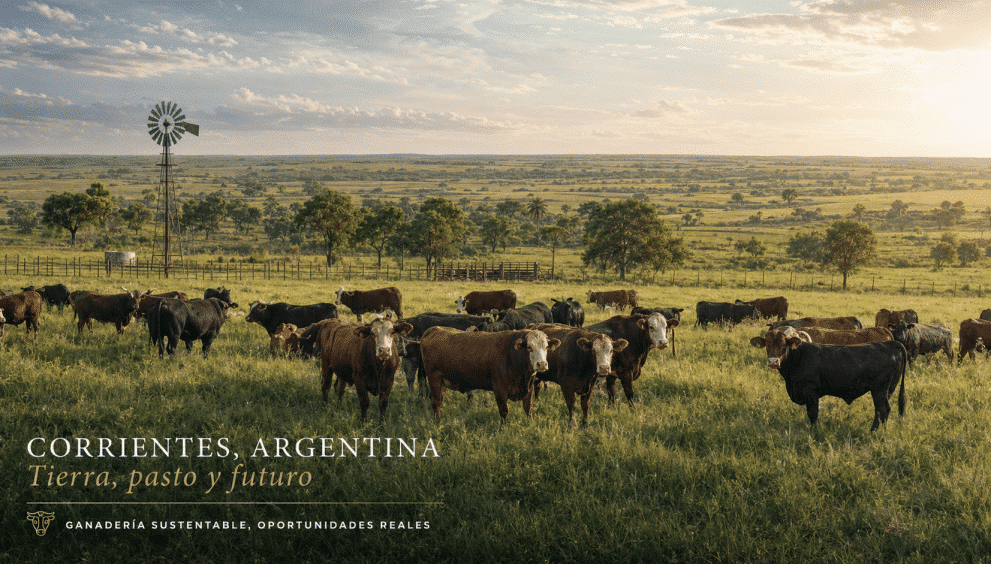
Corrientes forms part of Argentina’s Mesopotamia region and is widely recognised as a traditional livestock province, with a long history of cow–calf operations on natural grasslands. While cropping plays a smaller role than in the central Pampas, livestock is a core pillar of the rural economy and land use, especially breeding herds supplying calves to feedlots and backgrounding areas in other provinces.
Large areas are devoted to extensive and semi‑intensive grazing, using natural pastures, improved grasses and cultivated forages. The province’s high rainfall and river systems (including the Paraná and Uruguay rivers) support year‑round forage production when managed correctly. Growing investment in fencing, water points, and pasture improvement is steadily increasing carrying capacity and productivity, moving Corrientes from a purely extensive model toward more efficient, professional systems.
Road corridors link Corrientes to major slaughter plants and feedlots in nearby provinces, as well as to export outlets via industrial centres and river ports. This gives investors exposure to regional and national beef supply chains while still benefiting from comparatively competitive land values for breeding operations.
Production Systems and Genetics
Cattle production systems in Corrientes have historically been dominated by cow‑calf operations, reflecting its strength as a breeding province. In recent years, backgrounding and more intensive grazing systems have expanded as producers invest in better pastures and infrastructure.
You will typically find three main production systems:
- Cow‑calf (breeding) operations producing weaned calves and replacement heifers.
- Backgrounding systems growing calves and yearlings on pasture to heavier weights before finishing elsewhere.
- Smaller‑scale feedlot or semi‑feedlot operations close to grain supply and slaughter plants.
While feedlot capacity is more limited than in grain‑heavy provinces, Corrientes is increasingly integrated into finishing systems through the flow of calves and feeders to outside feedlots. Within the province, growing use of cultivated pastures (such as Brachiaria and other tropical grasses), silage, and strategic supplementation is lifting productivity on what were once purely extensive ranches.
On the genetics side, Corrientes’ herd draws strongly on Braford, Brangus, Brahman and other Bos indicus or composite breeds, chosen for heat tolerance, tick resistance, and adaptation to humid subtropical conditions. Angus and Hereford genetics are also present, often in crossbreeding programs aimed at improving meat quality while retaining hardiness. Widespread use of artificial insemination and structured selection is gradually improving reproductive performance, growth rates and carcass traits—key drivers of long‑term returns in a breeding‑oriented province.
Current Cattle Price Environment
Cattle prices in Corrientes tend to follow national market dynamics, with local values influenced by demand from feedlots and slaughter plants in the central belt and by exports. Periods of strong demand for feeder cattle typically translate into firm prices for calves and young stock, which is particularly important for a breeding province like Corrientes.
When national beef prices rise—whether due to strong export demand, reduced herd size, or macroeconomic factors—Corrientes benefits from higher sale prices for calves, cull cows, and finished animals. In recent years, breeders have experienced better price relationships relative to their historical averages, especially when supplying organised commercial buyers and auctions with consistent quality.
For investors, the key point is that Corrientes is positioned on the “supply side” of the cattle chain: it sells a large share of its production as breeding stock and feeders into higher‑value finishing regions. This means that when feeder prices are strong relative to finished cattle, Corrientes breeding operations can capture an outsized share of the value being created further along the chain.
From Prices to Profitability
High nominal prices, by themselves, do not guarantee high profitability. What matters is the relationship between sale prices, production costs, and the capital locked up in land, infrastructure and stock.
In Corrientes, the traditional advantage has been relatively lower land values for grazing compared with the core cropping provinces, combined with a climate that supports year‑round forage production. When producers invest in better grazing management, water infrastructure, pasture improvement, and genetics, they can significantly increase the kilograms of beef produced per hectare, often with comparatively modest additional capital.
As a result, well‑run breeding and backgrounding operations can generate attractive margins even if local prices are slightly below those in central auction markets, because their cost base—especially for land and feed—is competitive. The most profitable models tend to be:
- Efficient cow‑calf operations with good fertility, low calf mortality and strong weaning weights.
- Backgrounding systems that take advantage of improved pastures and strategic supplementation to add cheap kilos before sale.
Feedlot economics inside Corrientes itself can be more variable, since local grain availability and logistics differ from those in core grain areas. However, where producers have access to grain or by‑products at competitive prices, on‑farm or regional finishing can add an extra layer of value.
Returns on Capital for Investors
When analysing Corrientes as an investment destination, it helps to separate three levels of return: operational return on livestock and working capital, return on total farm capital (including land), and total investment return including land appreciation.
- Operational returns (stock and working capital)
In efficient breeding and backgrounding systems, current price levels and productivity improvements can support solid real returns on livestock capital. Because land is generally cheaper than in high‑value cropping provinces, operations can allocate more of their budget to improving pastures, genetics, and management, thereby increasing cash yields from the herd itself. - Return on total capital (including land)
Grazing land in Corrientes has historically offered lower per‑hectare values but good productive potential. When cattle margins are calculated against the full value of a well‑improved ranch, returns on total capital from livestock may be moderate in average years but rise significantly as management and stocking rates improve. Investors who buy properties with underutilised potential and invest in targeted upgrades (fencing, water, pastures, stock handling) often see meaningful uplifts in both income and capital value. - Total investment return (operations plus land gains)
Over time, total returns are driven by both operating cash flow and land appreciation. In Corrientes, infrastructure expansion, tourism and conservation initiatives, and the steady professionalisation of livestock businesses can all contribute to rising land values, particularly for properties with good access, water and development potential. Combining operational returns from cattle with conservative expectations of real land appreciation can deliver a balanced long‑term return profile for patient capital.
Risk Factors and How to Manage Them
Despite its advantages, Corrientes presents several risks that investors need to consider:
- Price and market risk. As a breeding province, Corrientes is exposed to fluctuations in feeder prices and national demand from feedlots and packers. A downturn in finishing margins elsewhere can depress calf prices locally.
- Climate and environmental risk. High rainfall and wetlands mean that flooding, waterlogging and infrastructure damage are recurrent challenges, while dry spells can also affect pasture growth. Good planning for drainage, road access, and pasture resilience is essential.
- Health and management risk. Humid conditions and the presence of parasites and diseases require systematic health programs and appropriate genetics. Operations that cut corners on herd health can see productivity losses that erode returns.
- Policy and macroeconomic risk. As in the rest of Argentina, changes in export policy, taxes and macro conditions affect realised returns, especially for foreign investors.
Mitigation strategies include focusing on properties with good natural drainage and access, investing early in infrastructure and herd health, diversifying between breeding and backgrounding, and partnering with experienced local managers who understand both the production and regulatory environments.
Where the Best Opportunities Are Emerging
For investors, Corrientes’ cattle sector offers several attractive avenues:
- Scale breeding ranches. Large cow‑calf operations with scope for pasture and infrastructure improvement can deliver a strong uplift in productivity and value over a medium‑term horizon.
- Breeding and backgrounding combinations. Properties that can wean calves and then add weight on improved pastures before sale capture more value per animal.
- Projects focused on genetic and management upgrades. Investments in superior bulls, artificial insemination, and structured grazing can transform underperforming ranches into efficient, scalable operations.
- Blends of livestock and conservation/tourism. In some areas, cattle ranching can be combined with eco‑tourism, hunting or conservation initiatives, diversifying income and enhancing land value.
A Province with Long‑Term Potential
Looking ahead, the cattle industry in Corrientes is set to keep evolving as producers adopt better management, genetics and infrastructure, and as investors bring new capital and expertise. With its strong natural resource base, low relative land costs, and strategic role as a breeding province, Corrientes offers a distinctive opportunity within Argentina’s broader cattle landscape.
For investors seeking exposure to real assets, food production and long‑term capital preservation, Corrientes provides a platform for building value through disciplined acquisition, careful development, and professional livestock management.

Founded in 2004, GTSA began as a single office in Buenos Aires. Since then, it has grown into a vibrant regional network, providing professional real estate marketing services to clients in AR, BR, CL, PY, PE, and UY.

