


This post is also available in:  Español
They fought as members of the Allied forces in the greatest conflagration in history against fascism. Many died without recognition, and others now tell their story for the first time.
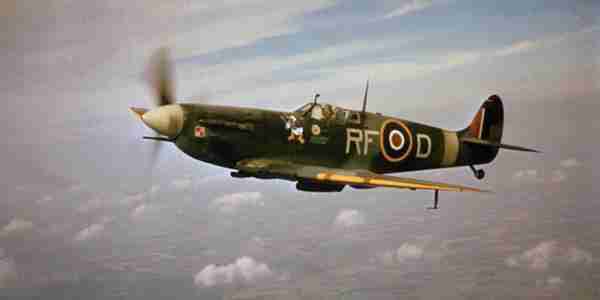
Fourth of July, 1944. The beaches of Normandy are the scene of one of the most famous battles in history. They cross two Spitfire aircraft from the RAF, the Royal British Air Force, through the sky. On the other side, in the same sky, forty German planes. Two against forty, that simple.
RAF pilots don’t cower. On the contrary, they face the German formation in front to disperse them, and, given the persecution, they demolish two planes each. The German unit Richthofen embarks on the retreat. The sky of Normandy opens free for the victors and crosses the beaches without knowing that there, that very July 4 1944, a group of journalists visits the theatre of war. These chroniclers who write the feat will leave these two pilots, Kenneth Charney and Pierre Clostermann, in the great history of the twentieth century.

But that same big story will forget one detail: neither of those two RAF pilots was British. Clostermann, famous French pilot and remembered by many for his emotional letter to Argentine aviators of the Malvinas, was, in fact, Brazilian. and Kenneth Charney, baptized as the Black Knight of Malta-one of the best and most fearsome pilots of the second war an Argentinean born in Quilmes enrolled as a volunteer to fight against fascism.
There were about 4,500 Argentines who presented on their own will to fight alongside the Allies in the second war. While most were men, many women also served. For years, no one rescued their stories. They weren’t even forgotten. No one knew them except one man (which we will then present). But the rest of the people don’t. Or did anyone ever hear the story of Stanley Coggan? Do you know the name of Pedro Davreux? Do you know who Irma Weys, Ronnie Scott or Peter Harrison are? Fame is a cheating animal lying on the skirt of false gods. But what does fame matter? They would say that if, in the end, it fulfilled the task, True? What would fame matter if the prize were to live in a world without Hitler?

Of those 4,500 men and women, some live. To 17 of them, those who were located and were in a position to attend (all are over 90 years old), were honoured last September at the National Congress. “The Argentine state took a long while to recognize them. They had no doubts that they were not sent by the government but were to defend their freedom. They knew very well what to do when the Argentine Government was not clear on what role to take. They have been generous in offering their lives for a free world, said Congresswoman Lucila Lehmann of the Civic Coalition, one of the organizers of the homage, along with the deputies Marcela Campagnoli and Elisa Carrió. In addition to giving them a diploma, it was recalled the presentation of a bill. Still, without resolution, it proposed to appoint May 8 as the day of the Argentine volunteer of the Allied forces in the Second World War.
Let’s continue with our pilot from Normandy. Son of an Englishman installed in Argentina, Kenneth Charney was born in 1929 in the Buenos Aires suburbs but grew up in Bahía Blanca. I was 19 when World War II broke out. Like so many other Argentines, he appeared as a volunteer to join the Allied forces against Nazism. At the end of 1941, he came into battle for the first time in the legendary defence of Malta. There, he knocked down his first plane. Aboard a Spitfire, it is said of him that, in total, he topped 12 enemy aircraft, a very high number for any pilot. It was undoubtedly the most feared Argentine aviators in the great conflagration of the twentieth century.
His tactic of attacking in front of the squadrons of German planes to disperse them and attack one at a time earned him the nickname of Black Knight. Later, he met and had his orders to the Clostermann above, one of the most famous pilots of the conflict-23 demolitions!-, with whom they attacked together Normandy with the same strategy.

He had countless missions. In December 1944, he was sent to Sri Lanka to prepare for an attack in Southeast Asia. But the mission never happens. The conflict ends, and he continues his career in the RAF until 1970, when he retires as a colonel and Avoca to a completely different life. He becomes a hippie wandering in a van for Europe. He died of cirrhosis in Andorra, also affected by cancer caused by exposure to radioactive material on Christmas Island, where he was on a mission during nuclear experiments.
There is a scene that few know: Charney is greeted at Buckingham Palace in 1944 by King George VI. It is accompanied by Argentine ambassador Miguel Ángel Cano. There, you will be decorated for what is done in Normandy. But the news will not reach our country or the shores of his house in Quilmes. Never, even today.
Peter Harrison is 94 years old and lives in the country in Ameghino. He was a student at St. George’s School when the conflict erupted. The director entered his class and announced to them that England had declared war on Germany. As soon as he heard it, he knew he would not finish his studies. He would have to participate in that war. “I passed a shiver through my body. My father had been a career officer, so there was a certain tradition… That’s why I knew instantly that when I turned 18, I would have to go. I knew that and didn’t think about it until the time came. “

That was the end of the school as a volunteer, and in April 1942, he left for England. He registered and sent him to Canada to perform his training as an artillery soldier. Already formed, he returned to Europe, where he began his officer training. Was 1944. “The Allies were already expected to move forward in Europe, but troops were needed to combat Japan, which was not surrendered. So they asked for volunteers to go to India, and I enlisted. I didn’t hesitate. I wasn’t scared. I knew what could happen, but. What will be, will be, right? If you were frightened, life would become impossible. So we went on a boat. I liked to sit on the bow and look at the waves. Sometimes, some dolphins swam beside us. Since I was a gunner, I was in charge of the nights of guarding in case a fighter or a bomber crossed us. He was sure he would take it down if a German plane appeared. He had no doubts, “he says in his family’s house in Martínez, where he visits once in a while.
“What did he think of Hitler? It was disgusting. He had to be liquidated. He was all that one did not want in a leader. A violent murderer. A madman. Can you imagine living under the Nazi control regime? No justice, no right, no freedom. Once, a long time later, I was travelling in a group here in Argentina and had a blond boy next door. He was German and had been part of the SS, one of the most violent factions. I don’t know what I said, and he said, ‘ It’s that I didn’t come in voluntarily. They came to high school when they were 17 years old, asking for volunteers for the SS, and those who did not want to enter were sent to the Russian front without training. ‘ And he told me that he preferred to enter the SS before he fought the Russians, what I know. I was thrilled to have offered my life to face that atrocity. “

Another unknown hero, Peter, son of Belgian parents, was born in 1912 in Buenos Aires. After completing his studies, the Argentine army summoned him for compulsory military service. The weapons were not in Peter’s plans; he was already engaged in dealing with European clients in his father’s company. He claimed he would do military training in the Belgian army and was excused. Shortly after, the Belgian army summoned him to serve. He refused, giving up his second citizenship.
Soon after, however, peace in the world ended. His European clients began to tell Peter the horror that was starting to be lived, the Nazi occupations, the exiles, the abuses. Then, he was born in a dodging vocation: he went to the Embassy of Belgium in Buenos Aires and enlisted as a volunteer. He did not want to provide compulsory service; I wanted to fight Hitler.
He wasn’t the only one in his family. His brother John also enlisted, and his mother and two sisters travelled to their hometown in Belgium to offer assistance and support their own. Years later, the story ends with Peter falling into a parachute while his flaming plane crashes into the firmament. In between, the following story happened, rebuilt here thanks to the work of the writer Claudio Meunier, the man mentioned at the beginning, a specialist in the subject and author, among others, of flew to live, where he tells stories of some of these heroes. With his work and dedication, he was among the first to pay homage to him. It is also the person who found the tomb of the Black Knight of Malta in Andorra and regained his story, which he is writing for his next book. Before, he also repatriated the remains and buried them in Chacarita. It was vital for this note (for those who wanted to contact him or get his book, he offered to communicate his mail: claudio.meunier@gmail.com).

Let’s go back to Peter’s story, then. He arrived in Canada in May 1941 to perform his training. It was formed as a private and up to Great Britain in August of that year. In April 1942, he was recruited for the Belgian section of the RAF. They don’t recognize his training and send him back to Canada. Stoic performs the same tasks again, body to the ground, and the same discipline rituals. He’s about 28, and he’s old to be a pilot. They offer you to be a bomb launcher and suggest you change your name if you fall prisoner of the Germans. Then, Louis Robert is baptized.
He returns to Europe, now ready for war, and it is the war who receives it: he is informed that his mother and sisters were captured by the Nazis for assisting Allied pilots shot down. They sent them to the extermination camp of Mauthausen.
The first revenge will have it on August 27, 1944, on board a Halifax on a mission in the German city of Hamburg. After that, it begins to have missions, one after the other, until September 23. After attacking a railway training centre, his plane is hit by a Messerschmitt night fighter, and after several manoeuvres, his commander orders him to leave the aircraft. He parachutes along with another partner. With the pilot and another soldier on board, the ship bursts into the ground. The parachute of the one who pulls along with him never opens. Peter’s yes, about the hour, and though he survives, he hurts the spine when he falls. They will save it, and then some Dutch locals will keep it hidden until they arrive to rescue him. He will be sent to England. Months later, after being interned and recovering, he rejoins his brother Juan and receives the news that his mother has been killed in the extermination camp, but his sisters were rescued by a young Belgian named Claire. Peter married her on August 6th, 1946. She’ll come back to Argentina with him. She has rested since January 17, 2003, in the vault of the family Davreux in the cemetery of Namur, Belgium.

He remembers the day he had to land in the water. “The engine failed. I don’t know what I thought then, but the Navy teaches you that you’re not dead until you are. Then, Planché put the most appropriate speed to control it by lowering its nose, and when I saw the waves coming, I glided into them, landing in the water. It ended perfectly, but I got a tremendous blow to the head. I’ve been unconscious for two or three seconds, but if we’re sitting here drinking tea, it’s because it looks like I survived, right? ” He who speaks is perhaps one of the pilots of his most recognized generation. It is 101 years old, it is called Ronald David Scott-it is known as Ronnie-, and was one of the 270 Argentine pilots of the RAF.
“The British community here was aware of what was going on. They had already fought the Germans in ‘ 1914. They knew who they were. You couldn’t forgive them for what they were doing. It was something concrete and inescapable. In our country, things happen often, and nothing is done. There’s a phrase I’ve heard so many times that it says, ‘ and, well. ‘ But at that moment, you could not say ‘ and… well ‘. We had to do something, and we did, “he says.
His life relationship with an armed conflict did not end there: Almost forty years later, his son would be a pilot in the army. With a difference: I would not fly in defence of the British Crown but against, as part of, the Argentine Army in their failed attempts to recover the Malvinas Islands.

John Gifford’s Stower was born on September 15, 1916, in the province of Jujuy. He enlisted as a volunteer and was part of the RAF as a pilot for a Wellington bomber. After several missions, his plane was shot down and landed in the water. He survived along with all the crew but was captured by the German army and sent to Stalag Luft III, a prison camp. From there, he managed to escape and let himself be recaptured to start a more extensive plan: to organize a massive escape.
They did so: 75 British prisoners, many of them from the RAF, escaped from that prison. However, they were recaptured. By direct order of Hitler, who felt that his army had been embarrassed by the escape, 50 of those prisoners were executed, among them the Argentine John Gifford Stower, one of the brains of that great escape. He was shot somewhere in a German forest.
His story was immortalized: he is one of the characters in the film The Great Escape (1963), with Steve McQueen and James Garner. But again, a detail is omitted: that free man was also Argentinian.
Stanley takes my hand. Thank you, he says. Thank you. In his eyes, there are two crescents of tears. They don’t fall. They’re contained under their red eyes. Despite his 94 years, he has a strong voice. It takes a while to walk through an injury that drags on the spine since his plane had to land emergency on April 1, 1945, in German territory. But it has a strong character like an oak. The Coggan Oak, aboard a Halifax, flew flush to stop fascism. Someone could write their legend in the many chronicles of the Great War. In your case, it will be written now, in these lines that arrive in time. Although not all heroes could wait, he did.
Living in a first-floor apartment in Lomas de Zamora. There are badges from different countries hanging on the wall. An original coat of arms, a Viking sign, and welcome Danish posters. Two honorary diplomas coexist in the room, one to Stanley’s father on behalf of the British Crown for having fought in the First World War. Another, next to the Congress of the Argentine nation, to him, for having fought in the second.
“In 1942, I turned 18 and told my father I wanted to go volunteer. He told me he couldn’t stop me because he was also a volunteer in ‘ 14. And that’s how Zarpé convinced me on December 10th of that year. I had always been a defender of democracy. And before Hitler came to Argentina, he would fight no matter where he went. He really was a man without a heart. He liked to be what he was: a dictator, “he says.
He carried 14 missions aboard a Halifax Quadbike and 15 in a Lancaster. “What did he feel while piloting?” he repeats after listening to the question. It does not take long to answer: “Nothing. We took two drugs: one to stay away because we had many missions at night and another for emotional tranquillity. So I felt calm. To be a pilot, you must have a heart of marble and forget all the rest. Because there’s so much to do that’s impossible if you don’t. A goal must be fulfilled, and that is how we won the war, “he recalls.
On April 3, 1945, it was all over. He was sent to bomb a railway hub in the Ruhr area, Germany. It was the day that the drugs stopped working. Stanley had worked for over two years in a central railway station in his native climbing remedies, south of Buenos Aires suburbs. And now he had to destroy some sort of model of his home. He did it, though.
“I was bombing, and I felt very affected. Can you imagine what it meant to me? It was like bombing my own house. And that made me sick. So, as I returned, I was stunned, and a shrapnel of anti-aircraft cannons came to destroy one of the aircraft’s internal engines and injured my leg. Besides, he left the landing engine broken. I warned the base, and they told me to consider landing in the channel of La Mancha, i.e., to land in the water. I’ve got juice, I responded. I have oil. I have fuel! Do your best to get to Dover, they said, South of England. Then, I gave the order to remove all heavy materials and also demanded to throw out our parachutes, including my seat cushion. So we had to land forcibly without landing gear and sitting in metal seats. I did it, and nothing happened to the crew, but I hurt the base of my spine and leg. It was my last assignment. I spent 30 days in the hospital, and after five days of leaving, the nightmare was over on May 8th, 1945. “
When he found out, he knelt down and looked at the sky. It was a lot of people who then looked to heaven to thank. “I had chosen to be a pilot because, of all the possibilities I had, being in heaven was the one that put you closer to God,” he says.
“Thank you, I thought. My bit of sand worked, I thought. God helped me. Yes, I thought so. To this day, I still think the same: God helped me to be 94 years old and to still stand up. “
He was demobilized on 25 July 1946. On the 29th, I got on the boat and left London for Buenos Aires.
What do you feel, Stanley? What does it mean to have been there?
I think it is part of my story. I’ve been through pretty things and ugly things. But I always propose something better. I can not complain about what I have lived through, especially at this time when we need to all pull on the same side. The cinch is all or nothing, and I was close to nothing. That’s why I pray in the morning and at night for peace and tranquillity and for us to see the pretty things in this world. War, No. I don’t want to know any more about wars. If there was another war, I’d throw myself off the balcony because past wars have achieved nothing.


The New Zealander has a distinguished career of over 30 years in 7 countries, specializing in South American real estate, agriculture, and commercial matters. As the founder of Gateway to South America, he is known for his discretion, expertise, and experience in representing active clients in the region. His extensive knowledge of the market has positioned him as a leading authority and trusted advisor.

