


This post is also available in:  Español
After nearly 12 hours of debate, Argentina’s Senate granted initial approval to the Ley de Inviolabilidad de la Propiedad Privada by 37 votes to 33. However, the final text removed the chapters dealing with foreign purchases of rural land and the Ley de Manejo del Fuego, so the bill now moves to the Chamber of Deputies without altering the current Rural Lands Law.
What remains unchanged
The Rural Lands Law, enacted under former president Cristina Fernández de Kirchner, therefore remains in force, including its 15% ceiling on foreign ownership of rural land at the national, provincial and departmental levels. Milei’s earlier attempt to change that framework through his December 2025 congressional proposal has, for now, failed because the Senate stripped those provisions from the bill.
This matters because the law applies specifically to rural land. Urban real estate—apartments, houses, commercial premises and land within cities or towns—has never been subject to the Ley de Tierras restrictions: Argentines and foreigners can purchase it freely.
Foreign ownership: Argentina
Foreign individuals and companies currently hold about 13.2–13.3 million hectares of rural land in Argentina, roughly 5% of the country’s rural territory.

At the provincial level, no province has reached the 15% legal threshold. The highest reported proportions are:
| Province | Foreign-owned rural land |
|---|---|
| Salta | About 11.4% [4] |
| Misiones | About 11.3% [4] |
| San Juan | About 10.4% [4] |
Historical registry figures placed Salta at 11.56%, Misiones at 11.07% and San Juan at 10.48%, confirming that the provincial cap has not been breached.
The national picture is more restrained than some of the political rhetoric suggests: foreign-held rural land increased by roughly 781,000 hectares between 2018 and 2026, a modest movement relative to Argentina’s approximately 266 million hectares of rural territory. There are, however, more concentrated pockets: 31 departments or municipalities reportedly exceed the 15% threshold, even though their provinces remain below it.
Regional context
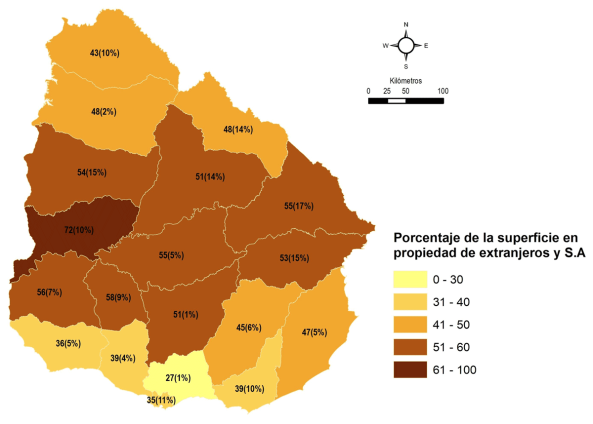
Argentina’s regulated system contrasts sharply with Uruguay, where foreign ownership of farmland is generally unrestricted. Between 2007 and 2020, foreign-controlled companies reportedly acquired control of roughly 7 million hectares—close to 40% of Uruguay’s agricultural land—making foreign participation there structurally more significant than in Argentina.
| Country | Foreign rural-land framework | Approximate foreign-held/control share |
|---|---|---|
| Argentina | 15% statutory ceiling, with national, provincial and departmental limits | About 5% / 13.2–13.3 million hectares |
| Uruguay | No broad foreign-ownership cap | Roughly 40% of farmland under foreign-controlled companies, 2007–2020 |
| Chile | No general nationwide cap on foreign ownership of ordinary rural property, though border-zone and strategic-area rules can apply | More open than Argentina, subject to location-specific restrictions |
| Paraguay | Generally open to foreign ownership, but constitutional restrictions apply in border-security zones | More open than Argentina outside restricted border areas |
| Brazil | Foreign acquisitions are regulated and subject to registration, area limits and national-security restrictions | More regulated than Uruguay, but structured differently from Argentina’s 15% model |
For investors, Argentina remains relatively open in urban property and accessible in rural property, but it retains a clearly defined national-interest framework around farmland. Uruguay is the regional outlier for openness, while Brazil, Chile and Paraguay use a mix of registration, border security and strategic territory controls rather than Argentina’s broad percentage cap.
What the Senate approved
Although the rural land reform was removed, the Senate-approved bill still contains important private property changes.
- Expropriations: Public utility must be interpreted restrictively, and the measure must satisfy suitability, necessity and proportionality tests. Asset valuation is tied to the point immediately before state action that may have distorted the property’s price.
- Compensation: The Senate version restored loss-of-profit considerations in compensation, improving the position of owners compared with the earlier December draft, which excluded them.
- Illegal occupation: The proposal creates faster eviction procedures, including earlier restitution when the asserted ownership or possessory right appears credible, as well as electronic notification mechanisms.
- Rental defaults: A tenant must receive a 10-day formal demand before accelerated action can begin, potentially shortening cases that historically could take years—particularly relevant for landlords in CABA.
- Property registry: The bill also retains provisions related to the modernisation and digitisation of property registration systems.

The New Zealander has a distinguished career of over 30 years in 7 countries, specializing in South American real estate, agriculture, and commercial matters. As the founder of Gateway to South America, he is known for his discretion, expertise, and experience in representing active clients in the region. His extensive knowledge of the market has positioned him as a leading authority and trusted advisor.

